







Introduction
Automated personalization in AI outreach campaigns enables organizations to scale engagement while maintaining relevance for each recipient. By combining workflow triggers, segmentation logic, and dynamic message templates, outreach managers can deliver targeted communications at volume—without the repetitive manual effort typical of traditional approaches. For technical leads and compliance officers, the core value of AI outreach personalization automation lies in its ability to orchestrate large-scale campaigns with operational transparency and built-in oversight.
Today’s landscape demands more than basic mail merges or surface-level customization. Modern AI-driven outreach systems—such as those described in official guidance from the OECD and the Federal Trade Commission—integrate privacy safeguards, auditable workflows, and compliant data handling at every stage. As a reader responsible for improving outbound engagement, you will leave this guide equipped to design, implement, and monitor AI-powered personalized outreach that aligns with both organizational goals and regulatory standards.
This article delivers a clear, modular breakdown of automated personalization mechanisms, visualizes manual and AI-powered workflow distinctions, and provides a scenario-based overview of operational risks and compliance criteria. You will find actionable guidance for workflow selection, phased implementation, and mistake prevention, grounded in verified technical and regulatory evidence rather than broad claims. By the conclusion, you will have a practical framework for deploying personalized outreach automation—balancing efficiency, accuracy, and trust at scale.
Effective AI outreach personalization relies not only on sophisticated algorithms but also on careful integration with existing data sources, robust consent management practices, and continuous monitoring for policy adherence. Stakeholders must decide how to map organizational data into segmentation rules, configure workflow triggers that respond to real-time events, and enforce access controls that prevent unauthorized use of personal information. Transparent documentation, regular compliance oversight, and periodic workflow audits are essential to ensure each step of the automation process maintains data integrity and respects user privacy. With these foundations, teams can confidently move from strategy to execution, knowing that operational and regulatory requirements remain central throughout the outreach lifecycle.
- Illustrative scenario: Configuring AI-driven personalized outreach
- Decision steps for selecting and integrating AI outreach automation
- Visual summary: Manual vs. automated personalization workflows
- Implementation table: Steps to deploy automated personalization
- Common mistakes and fixes in AI outreach personalization automation
- Checklist for compliant and effective AI outreach personalization
- Definitions: Core terms in AI outreach personalization automation
- FAQ
- Conclusion
Illustrative scenario: Configuring AI-driven personalized outreach
Illustrative scenario: An outreach manager at a mid-sized organization is tasked with deploying automated AI outreach personalization for a product launch email campaign. The goal is to maximize engagement by using workflow-driven personalization while maintaining compliance and operational oversight. This scenario outlines configuration steps and key decision points—without inventing outcomes or performance claims. When configuring automated outreach, organizations must consider the use of big data and AI to enable personalized experiences, which can carry both opportunities and risks for consumers.
Step 1: Initiating the Workflow with Triggers
The manager begins by selecting workflow automation triggers supported by the chosen platform. For instance, triggers may include new lead capture, contact behavior (such as email open or link click), or a scheduled campaign launch date. According to product documentation, triggers must be aligned with both campaign goals and available data streams. Proper selection ensures each recipient enters the workflow only when relevant, preventing unnecessary or redundant outreach. The manager also determines which trigger conditions require manual override or escalation to maintain control over high-sensitivity segments, documenting these exceptions within the workflow configuration for transparency and later audit.
Step 2: Data Input and Audience Segmentation
Next, the manager uploads the contact database, mapping fields such as industry, location, and prior engagement history. Segmentation logic is configured so that contacts are grouped dynamically based on profile attributes and behavioral signals. For example, enterprise leads in the finance sector may form one segment, while retail prospects form another. This segmentation determines which message templates and personalization rules are applied downstream. At this stage, the platform’s segmentation engine may reference real-time updates from integrated CRM sources, ensuring that segments remain current even as contacts’ statuses or attributes change. The outreach manager reviews segment definitions to ensure consistent application of business rules and compliance flags, especially where consent status or regulatory exclusions may affect inclusion.

Step 3: Message Template Logic and Personalization Variables
The platform supports assigning dynamic templates to each segment. The manager configures templates with personalization variables—such as recipient name, company, recent product interactions, and segment-specific value propositions. Template logic defines fallback values to handle incomplete data and ensures regulatory messaging is appended where needed. The system is reviewed to verify that each template’s variables correspond to mapped fields in the contact database. The outreach manager also leverages conditional logic blocks within templates to further tailor content based on segmentation outputs, and establishes a hierarchy for personalization variables so that higher-priority data points override defaults where possible. Each template is tested with sample data to validate rendering and compliance placements before approval.
Step 4: Integrating Compliance Checks and Oversight
Prior to activating the campaign, the workflow incorporates compliance controls. This includes automated consent verification, suppression of contacts lacking explicit opt-in, and logging of message variant assignments for audit trails. The organization references regulatory requirements (such as those described by the OECD and the Federal Trade Commission) to ensure that personalization logic does not introduce bias or non-compliance. Operational oversight is established via dashboard alerts and scheduled workflow reviews, making it possible to halt or adjust the campaign if irregularities are detected. The outreach manager configures automated alerts for unusual patterns—such as spikes in opt-out rates or delivery errors—and assigns response protocols, ensuring any compliance breach is rapidly escalated and documented for future audits.
Step 5: Final Review and Activation
After a comprehensive review—including access control validation and template preview—the outreach manager schedules the workflow for activation. Operational documentation is updated to reflect trigger logic, segmentation rules, template mappings, and compliance checkpoints. The scenario concludes with the process ready for monitored execution, rather than reporting hypothetical results or measured engagement rates.
Decision steps for selecting and integrating AI outreach automation
Implementing AI outreach personalization automation requires a disciplined, phased approach. The process begins with a clear understanding of business objectives and operational requirements, advances through evidence-driven provider and technology evaluation, and culminates in integration and risk-managed deployment. This section delivers a structured sequence of decision points and actions, grounded in both operational realities and authoritative compliance frameworks. When evaluating platforms, the AI outreach provider comparison highlights how privacy, performance, and integration requirements can drive your decision. Selecting and integrating AI for outreach automation should follow principles for trustworthy AI to ensure that transparency, accountability, and fairness are prioritized throughout the workflow.
Stepwise process for provider selection and integration
- Define objectives and operational constraints: Document outreach goals, key engagement metrics, existing infrastructure, and any sector-specific compliance obligations. This foundation sets realistic boundaries for automation scope and data flows.
- Evaluate provider data stewardship and integration options: Assess how each potential AI provider manages data (controller vs. processor roles), supports integration with your CRM or messaging systems, and offers transparency into data processing. Review the provider’s official documentation for explicit statements on privacy protocols and technical compatibility.
- Determine key management requirements: Decide whether your operational context requires a product licence key (managing access within your organization) or a provider API key (direct authentication with an external AI service). Each approach affects auditability, revocation control, and exposure to third-party risk, as detailed in verified provider comparisons.
- Perform privacy and compliance checks: Map data flows against relevant regulatory frameworks, such as the OECD Principles on AI for trustworthy automation and, where applicable, FTC guidance on personalization data use. Confirm that the provider’s processes align with both international standards and local regulations, distinguishing your team’s controller responsibilities from the provider’s processor or deployer obligations.
- Plan integration for operational fit: Design integration points with an emphasis on modularity and the isolation of sensitive functions. Document how automation triggers, data mapping, and message templates will connect with your current workflows. Prioritize options that support clear audit trails and rollback mechanisms to minimize the operational impact of any failure or misconfiguration.
- Conduct operational and compliance testing: Before launching live outreach, perform controlled tests covering both technical reliability and regulatory conformance. Verify workflow integrity, error handling, and evidence of consent management. Maintain documentation of these tests for internal governance and external audit readiness.
Long-term integration and risk implications
Decisions made during selection and integration carry long-term consequences for operational resilience and compliance exposure. Integrations built on well-documented APIs and modular workflow designs can adapt to future regulatory changes or business needs with less disruption. Conversely, tightly coupled or opaque integration models may increase downstream risk and complicate incident response. Providers should be evaluated on their ongoing support for transparency, explainability, and data portability, as recommended by recognized frameworks for trustworthy AI.
Visual summary: Manual vs. automated personalization workflows
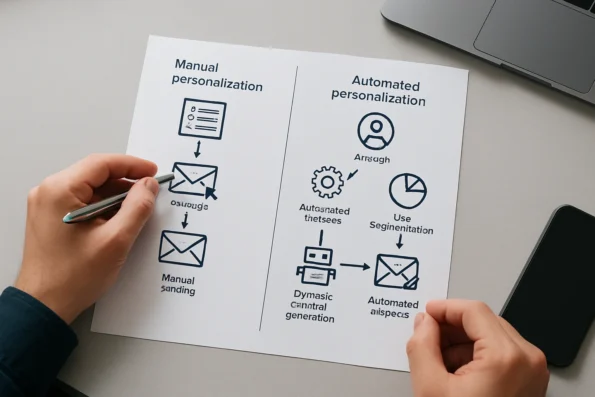
Understanding the shift from manual to automated AI outreach personalization requires a clear view of how process steps, triggers, and content variation are managed. The following diagram and structured analysis contrast traditional manual outreach with modern, trigger-driven automation, clarifying operational changes and the resulting impact on efficiency and oversight. Understanding workflow automation for content teams clarifies the operational shift between manual and automated AI outreach.
Workflow diagrams: Key distinctions
- Initiation: Human operator identifies outreach targets and segments lists by hand.
- Content customization: Individual messages are written or adjusted case-by-case, often relying on templates and manual research.
- Execution: Each message is sent manually or through batch scheduling, with limited dynamic variation.
- Oversight: Quality and compliance checks are typically reactive, requiring direct human review for each batch.
AI-automated personalization workflow:
- Trigger-based initiation: Outreach begins automatically in response to predefined triggers—such as data changes, user behavior, or CRM updates—configured in the workflow automation platform.
- Segmentation and content generation: Segments are dynamically built based on live data criteria. AI-driven engines generate or adapt message content in real time, applying logic for variants, tone, and compliance requirements.
- Automated execution: Messages are sent at optimal times or in response to workflow events, with dynamic variables inserted for each recipient.
- Operational oversight: Supervisory tasks shift to monitoring trigger logic, reviewing segmentation rules, and auditing automated outputs, often using dashboard alerts and logs to flag anomalies.
Operational impact of workflow automation
Automated AI outreach workflows reduce repetitive manual steps by leveraging workflow triggers, dynamic segmentation, and instant content generation. The operator’s focus transitions from one-off editing and message dispatch to configuring oversight routines, reviewing trigger criteria, and maintaining compliance documentation. This transformation, as outlined in recent analyses, enhances scalability and consistency, supporting teams to handle larger volumes without sacrificing control or accountability.
Furthermore, automation platforms often provide built-in controls to track workflow changes and flag exceptions, allowing operational leads to audit historical decisions and refine trigger conditions. This auditability is especially important for regulated industries where transparency around outreach decision-making is required. By configuring permission levels and access logs, organizations ensure that only authorized personnel can modify automation rules, supporting both data security and compliance obligations.
Where triggers and dynamic content fit
In the automated model, workflow triggers are central—they determine when and how outreach is initiated, integrating with segmentation logic and dynamic content engines. The interplay of these components allows campaigns to react to real-world events in near real time, offering a flexibility and precision that is unattainable in purely manual processes. Effective oversight remains essential, now oriented around proactive review of automated decisions and exception handling.
Implementation of dynamic content generation also requires careful management of template logic and variable substitution. Automated workflows may include fallback content rules and language adaptation, ensuring that messages remain relevant and compliant across segments. This design reduces manual intervention while preserving personalization quality, as documented in workflow automation research from NextlerAI (nextlerai.com).
Implementation table: Steps to deploy automated personalization
Effective deployment of AI outreach personalization automation relies on a structured, auditable workflow. Each stage—beginning with automation trigger setup and extending to ongoing monitoring—requires not only technical configuration but also systematic integration of compliance, documentation, and operational controls. The following table summarizes the distinct stages, aligning each with required documentation, key technical checkpoints, and compliance tasks to help reduce setup errors and ensure regulatory alignment.
| Implementation Stage | Operational Objective | Key Technical Prerequisites | Documentation & Controls | Compliance Task | Source |
|---|---|---|---|---|---|
| Trigger Configuration | Define event-based or scheduled triggers for outreach automation | Workflow engine access, event source mapping, permissions setup | Trigger logic documentation, change audit trail | Consent check, record of trigger events | NextlerAI official blog |
| Template and Personalization Variable Setup | Design message templates with dynamic content fields | Template engine, variable mapping schema, test dataset | Approved template library, version control | PII minimization review, template approval log | NextlerAI official blog |
| Data Mapping and Integration | Map outreach variables to CRM or data source fields | Integration API access, data field validation, error handling setup | Integration test report, data flow schema | Data transfer agreement verification, access restriction review | NextlerAI official blog |
| Access Control and Permissions | Enforce role-based access to workflow and personalization data | User access matrix, permission audit tools | Access control policy, change log | Least privilege review, rights assignment attestation | OECD Legal Instruments |
| Compliance and Audit Readiness | Implement monitoring, logging, and review mechanisms | Audit log configuration, exception alerting, review dashboard | Compliance audit checklist, monitoring reports | Regulatory reporting readiness, policy update tracking | Federal Trade Commission |
| Operational Monitoring and Error Handling | Continuously monitor outreach delivery and handle exceptions | Error alert setup, workflow health dashboard, SLA monitoring | Incident log, remediation process guide | Incident response protocol, impact assessment record | NextlerAI official blog |
Each stage of implementation requires deliberate coordination between technical and operational stakeholders. For example, during data mapping and integration, teams must not only ensure API connections are properly authenticated and validated, but also that data field mappings are exhaustively documented to prevent misrouting or exposure of personal information. Trigger configuration decisions must take into account auditability and the granularity of event capture, supporting both operational agility and regulatory traceability. Similarly, access control and permissions demand robust enforcement of least privilege principles, with periodic reviews to adapt to evolving team roles or compliance requirements. Audit readiness is underpinned by the establishment of continuous monitoring and documented exception handling, ensuring that issues are rapidly identified and remediated. By clearly delineating responsibilities and technical expectations at each stage, organizations can reduce integration risks and support ongoing compliance. Subsequent sections address frequent errors and troubleshooting in these workflows.

Common mistakes and fixes in AI outreach personalization automation
Even with robust planning, operational mistakes can undermine the effectiveness and compliance of AI outreach personalization automation. Systematic review and early detection of these errors are essential for sustainable, scalable campaigns. To maintain continual improvement and accountability in AI outreach personalization automation, implementing robust outreach performance tracking ensures that workflow adjustments are data-driven and compliant. One common mistake in deploying AI personalization is overlooking the societal impact and governance of AI systems, which may result in unintended biases or lack of accountability.
Credential confusion and access mismatches
A frequent operational error arises from mismanaging platform licence keys versus external provider API keys. For example, in platforms such as NextlerAI, the distinction between a product licence (which manages permissions within the deployment) and an external AI provider API key (which governs access to underlying models) is critical. Misconfigurations here can result in failed message delivery, data exposure, or unauthorized access. Always follow operational documentation to clearly map credential responsibilities and maintain a detailed log of key assignments. Strict access control and regular credential audits are recommended to prevent operational and security lapses.
Misaligned compliance controls
Automated workflows sometimes bypass required compliance steps if triggers and controls are not aligned with jurisdiction-specific privacy and recordkeeping obligations. For instance, compliance gaps can occur when automated outreach triggers do not enforce opt-in verification or neglect audit logging. According to OECD and FTC guidance, it is the responsibility of the deploying organization, not just the AI tool provider, to ensure lawful processing and transparency. Review workflow triggers and audit trails systematically, and update compliance documentation as regulatory requirements evolve.
Neglected integration prerequisites
Overlooking technical prerequisites during integration—such as CRM field mapping, webhook endpoint validation, or data synchronization settings—can result in broken personalization logic and message errors. Evidence from NextlerAI’s product troubleshooting guidance emphasizes the importance of pre-launch integration checks and ongoing monitoring of integration health. Maintain an integration checklist and verify that all data sources are correctly authenticated and mapped before activating automated messaging workflows.
Insufficient error monitoring and alerting
Poor monitoring for workflow errors and delivery failures is a persistent risk. Automated outreach systems that lack real-time error alerts or fail to capture exceptions in the audit log can propagate compliance violations or delivery gaps undetected. Platforms such as NextlerAI recommend configuring clear monitoring routines, actionable error alerts, and regular operational reviews. Refer to product troubleshooting documentation to customize alerts and escalation paths for your deployment.
Sustaining operational and compliance readiness
AI outreach personalization automation is not static: workflows, compliance obligations, and technical environments evolve. Establish a routine schedule for reviewing operational controls, updating credential inventories, and validating integration health. Consult platform-specific troubleshooting and compliance resources to keep your outreach automation resilient and aligned with current evidence-based best practices.
Checklist for compliant and effective AI outreach personalization
To ensure your AI outreach personalization automation aligns with regulatory, operational, and engagement requirements, use the following checklist derived from recognized compliance frameworks and operational best practices. Each item addresses a distinct control area critical for lawful, secure, and effective campaign execution in real-world organizational settings. This checklist is designed to be actionable by operational, technical, and compliance teams responsible for deploying and maintaining AI-powered outreach systems. It reflects current guidance from frameworks such as the OECD Recommendation on Artificial Intelligence and sector-specific privacy requirements, as well as operational controls highlighted by compliance specialists at NextlerAI. A frequent pitfall—misaligned messaging or off-brand personalization—can be mitigated by adopting structured processes similar to automated content brief generation, which reinforce editorial boundaries and compliance in outreach workflows. A compliant and effective AI outreach checklist should include requirements for transparency and explainability to build user trust and support responsible automation.
- Conduct a documented privacy risk assessment: Perform a structured review of all data flows, data types, and processing locations. Ensure assessments are updated to reflect changes in outreach workflows and vendor integrations, referencing both current regulatory standards and internal policies.
- Audit workflow triggers and automation points: Identify and log all workflow triggers (such as segmentation logic, template generation, or delivery scheduling) to confirm that all automation aligns with authorized purposes and has appropriate oversight mechanisms documented for audit readiness.
- Verify least privilege access control: Confirm that only personnel and service accounts with a legitimate operational need can access outreach datasets, triggers, and message templates. Review permissions to ensure strict separation of duties and support prompt revocation when roles change. This should include checks on API credentials and provider integrations to avoid accidental escalation of access.
- Maintain versioned operational and compliance documentation: Keep detailed, time-stamped records of workflow configurations, integration points, AI provider relationships, and consent flows. Documentation must be accessible to internal auditors and compliance officers as required by policy. Include change logs for workflow modifications, integration updates, and any exceptions or overrides.
- Validate third-party integration compliance: Review all external AI or automation provider integrations for alignment with documented data processing agreements, ensuring providers’ privacy representations match operational reality and that no unvetted data transfer occurs. Map each integration to a specific data flow and review provider compliance status regularly.
- Implement granular consent management and opt-out handling: Capture, store, and respect user consent for all outreach personalization efforts. Ensure that opt-in/opt-out status is enforced at each automation step and that revocations are processed without delay across all system layers. Audit consent records and test opt-out workflows regularly for reliability.
- Schedule regular operational and compliance audits: Set a standing schedule for reviewing automation logs, access records, consent flows, and integration points. Use both internal controls and external guidance (such as OECD AI principles and applicable national regulations) as the basis for these audits. Assign responsibility for audit execution and follow up on discovered issues.
- Monitor for regulatory and operational change: Stay informed about legal developments (for example, updates from the Federal Trade Commission or new OECD instruments) that may affect outreach workflows, and promptly update automation controls to maintain compliance and transparency. Subscribe to official regulatory bulletins and review your processes in light of new obligations or best practices.
- Test operational resilience and fallback protocols: Simulate workflow exceptions and provider outages to confirm the automation can gracefully handle errors or interruptions. Document fallback procedures and ensure staff are trained to respond when automation or integrations fail, maintaining both service continuity and compliance.
Definitions: Core terms in AI outreach personalization automation
Understanding the operational vocabulary of AI outreach personalization automation is essential for building reliable, compliant workflows. Below, we clarify core terms that underpin the configuration, deployment, and governance of automated personalized outreach campaigns. These definitions draw on technical documentation, regulatory frameworks, and recent domain analyses to ensure accuracy and practical relevance.
Personalization and Segmentation
Personalization in AI outreach refers to dynamically tailoring messages, subject lines, or content blocks to individual recipient attributes, such as language, prior engagement, or location. This is executed through automated data mapping and variable-driven template logic, not through manual editing. Personalization mechanisms may incorporate rule-based logic, token replacement, or conditional content blocks, with all logic auditable via system logs. Segmentation involves algorithmic grouping of recipients based on shared characteristics or behaviors, enabling differentiated outreach strategies. In automated workflows, segmentation is often triggered by real-time data sources and integrated with message templates for scalable delivery. Segmentation logic may use filters derived from CRM attributes, engagement history, or behavioral signals, with segment membership updates tracked for compliance and operational transparency.

Workflow Triggers and Dynamic Templates
Workflow triggers are precise, pre-configured events or conditions—such as a form submission, CRM update, or scheduled time—that automatically initiate a messaging workflow. Unlike ad-hoc manual sends, automated triggers enforce consistency and auditability by documenting when and how messages are generated. Triggers may be single-event or multi-condition, and should be version-controlled to support rollback or forensic investigation. Dynamic templates are predefined message structures containing variables and conditional logic, allowing the AI system to generate personalized content at scale from a single template definition. This mechanism reduces the need for repetitive manual customization and supports rapid adaptation to new segments. Template management systems may support branching logic, language variants, and change history logs as part of governance.
Access Control and Compliance
Access control in the context of AI outreach automation is the enforcement of permission boundaries over who can view, configure, or execute campaign components. Role-based access, audit trails, and least privilege principles help prevent unauthorized changes and support regulatory accountability. Permissions should be scoped according to operational needs, with periodic reviews and automated alerts for anomalous activity. Compliance encompasses adherence to legal, ethical, and organizational privacy and data use standards. Regulatory bodies such as the FTC and OECD specify that deployers of AI-driven outreach must document data flows, manage user consent, and ensure transparency of algorithmic decision-making. For global campaigns, complying with cross-border data transfer rules and local opt-in requirements is critical, as highlighted in recent legal guidance and official reports. Effective compliance mechanisms will often integrate automated consent verification, regional policy enforcement, and ongoing monitoring of workflow changes to maintain alignment with legal obligations.
Integration and Multilingual Automation
Integration refers to the technical connection of AI outreach automation platforms with other business systems—such as CRMs, analytics suites, and consent management tools—to enable reliable data synchronization, workflow triggering, and oversight. Effective integration supports operational scale while maintaining traceability and compliance. Integration strategies may include use of secure APIs, data mapping schemas, and event logging for auditability. Multilingual automation involves orchestrating personalized outreach across multiple languages and regions using automated translation and localization engines. Domain evidence indicates that such automation can introduce risks—including missed nuance, regulatory misalignment, and error propagation—if not paired with robust human review and compliance checks. Key issues include handling of language-specific consent, regional opt-out requirements, and consistency of legal disclosures. Practical guidance on these pitfalls is available through specialized analyses of multilingual AI workflow failures, such as those detailed at NextlerAI’s multilingual automation pitfalls guide.
FAQ
How does automated AI personalization work in outreach campaigns?
Automated AI personalization in outreach leverages dynamic content engines, workflow triggers, and segmentation logic to tailor messages at scale. The system detects recipient attributes or behaviors and inserts relevant variables into outreach templates, ensuring individualized content without manual intervention. This approach replaces repetitive human tasks with rule-based automation, while maintaining operational audit trails and access controls for oversight.
What steps are involved in deciding on an outreach automation workflow?
Deciding on an outreach automation workflow requires defining campaign objectives, mapping data sources, assessing compliance risks, and evaluating integration options with existing platforms. Teams should compare provider data governance, clarify trigger and template logic, and test operational fit before deploying at scale. Documented workflows and clear role assignment are essential for sustainable automation.
How do operational risks differ between manual and automated outreach?
Manual outreach risks include errors from inconsistent personalization, accidental data leaks, and missed compliance steps. Automated workflows introduce different risks—such as misconfigured triggers, insufficient audit logs, or over-reliance on provider systems—that can scale errors rapidly if not carefully monitored. Automation requires ongoing review of compliance, segmentation, and technical controls to mitigate these risks.
What are the exact implementation steps for compliant AI outreach?
Compliant implementation begins with privacy risk assessment, followed by mapping of data flows and trigger logic. The next steps are configuring access controls, integrating consent mechanisms, and establishing detailed documentation for all workflow and template changes. Regular audits and operational resilience testing are critical to verify ongoing compliance with jurisdiction-specific regulations and organizational standards.
Which mistakes most often undermine outreach personalization automation?
Frequent mistakes include using incorrect API or licence credentials, bypassing opt-in or consent requirements, launching workflows without full integration testing, and neglecting to monitor error logs. These missteps can result in compliance violations or failed deliveries, emphasizing the need for credential audits, pre-launch checks, and real-time monitoring of automation outcomes.
What definitions are critical for understanding AI outreach workflows?
Key definitions include personalization (dynamic adaptation of outreach content per recipient), segmentation (grouping contacts by shared criteria), workflow triggers (automated events that launch actions), compliance (adherence to regulatory and organizational rules), and integration (secure connection of automation with external systems). Precise understanding of these terms ensures effective communication and governance throughout campaign planning and execution.
Conclusion
Making the transition to AI outreach personalization automation requires a disciplined approach that blends technical rigor with ongoing governance. The decision is rarely binary; the right workflow depends on your organization’s risk tolerance, data stewardship obligations, and the operational complexity of your outreach. Teams must treat automation not as a set-and-forget task, but as a living system—subject to evolving regulatory scrutiny and business needs.
Successful adoption hinges on organizational alignment and careful calibration of both technical and compliance mechanisms. Beyond initial deployment, teams must establish explicit ownership for reviewing new regulatory requirements and for validating ongoing accuracy of data mapping, trigger logic, and audit controls. Regular review cycles should assess whether workflow triggers and access permissions still match actual business processes and data use. This review process reduces the risk of silent compliance failures and operational drift as third-party providers, integration endpoints, or consent requirements change over time.
Further, implementation decisions should be informed by a documented risk assessment that accounts for the granularity of segmentation, the exposure of personal data, and the intended scale of outreach. Cross-functional collaboration is essential to ensure that all privacy, operational, and business objectives are reflected in both workflow design and oversight routines. Whenever changes are made—such as onboarding a new provider, updating segmentation logic, or refining access control—these changes must be logged and communicated to all relevant stakeholders to preserve transparency and traceability.
As a next action, convene your cross-functional task force within the next two weeks to review current outreach automation controls and ensure that all technical and compliance responsibilities are clearly assigned and reflected in your documentation.