







Introduction
Automating content brief creation is a pivotal step for content teams aiming to scale output without sacrificing editorial quality or SEO alignment. NextlerAI Publisher equips strategists, editors, and SEO managers with a platform to transform source material into structured, consistent content briefs—ready for human review and seamless integration into WordPress workflows. This approach is designed not just for efficiency, but for robust governance: Publisher enables precise control over editorial boundaries, brand voice, and brief structure, ensuring each brief meets internal standards before content production begins.
For organizations balancing high content volumes with the need for accuracy and differentiation, automation must come with embedded safeguards. NextlerAI Publisher’s workflow is built around explicit role permissions, approval checkpoints, and WordPress-native scheduling. These controls allow teams to delegate routine briefing tasks to automation, while retaining decision-making authority over what goes live. In addition, Publisher’s inventory management and duplication checks help prevent near-identical articles and protect keyword strategy, minimizing risks like cannibalization or content overlap.
Operational transparency is central to Publisher’s design. Quality rules and reporting help editorial leads distinguish between minor editable warnings and hard blockers that require intervention, keeping the publishing process both fast and accountable. Automated creation of SEO metadata and contextual internal links means briefs are not only editorially sound, but also optimized for search visibility from the outset. Publisher supports granular configuration of brief templates, allowing organizations to standardize required sections, enforce editorial notes, and specify metadata fields to be completed before briefs move forward. This extends to version control and audit trails, letting teams track changes at every stage—crucial for compliance and continuous improvement in dynamic editorial environments. By the end of this guide, you will know how to set up, operate, and safeguard automated content brief generation in NextlerAI Publisher—clarifying which tasks can be safely automated, and which require continued editorial oversight. Detailed configuration options—including customizable brief structures, metadata requirements, and workflow checkpoints—let teams align automation with existing editorial policies. Teams benefit from audit trails and version control for every brief iteration, further supporting compliance and ongoing content quality management. This foundation ensures that automation enhances, rather than overrides, your strategic and editorial objectives. Next, we outline the key steps to audit your workflow readiness for automated brief generation.
Auditing Workflow Readiness for Automated Briefs
Before activating automated content brief generation in NextlerAI Publisher, content teams must methodically audit their existing editorial environment. This ensures automation integrates cleanly with established practices, preserves quality controls, and prevents operational oversights. A structured audit highlights dependencies, aligns permissions, and surfaces risks unique to automated workflows. The following ordered list details the essential steps for a robust self-assessment. Automated Content Generation: A Review of Technologies and documents the relevant background and implementation boundaries.
-
Catalogue Source Materials:
Itemize all content repositories, data feeds, and structured documents that Publisher will access. This includes proprietary research, editorial calendars, style guides, and approved topic lists. Ensure that each source is current, versioned, and accessible from within your WordPress environment. Gaps or outdated files can lead to brief inconsistencies or missed topics. Additionally, confirm that any third-party integrations or external knowledge bases are documented, and permissions for automated retrieval are properly configured within Publisher, as missing connectivity here will disrupt the automated briefing process.
-
Map Editorial Roles and Permissions:
Document the current editorial structure, including who holds authority for brief creation, review, approval, and editing. Align these roles explicitly with Publisher’s permission settings to prevent unauthorized automation runs or premature publication. Role mapping is fundamental to maintaining editorial boundaries and enforcing approval gates within the automated workflow. When mapping, cross-reference your existing editorial policy with Publisher’s available roles, ensuring that only designated approvers have access to sensitive automation triggers and that reviewers are notified at the correct workflow stages.

-
Assess Topic Inventory for Overlap and Gaps:
Review your existing topic database for redundancy, cannibalization risks, and gaps relative to your content strategy. Use Publisher’s topic management features to identify near-duplicate subjects or keyword overlap. Addressing these issues prior to automation minimizes the risk of unintentional duplication and supports a coherent content pipeline. For implementation, consider tagging topics by status (planned, in progress, published) and use Publisher’s reporting to visualize coverage areas, ensuring the automated workflow does not queue unnecessary articles.
-
Verify WordPress Scheduling and Cron Automation:
Confirm that WordPress’s native scheduling and cron job mechanisms are operating reliably. Automation in Publisher depends on these systems for timed brief generation and publication. Test scheduling with sample drafts to ensure that articles queue, progress, and publish as intended under your typical server load and maintenance routines. If you use external hosting or managed WordPress, verify with your provider that the cron environment supports the intervals and triggers required by Publisher, and adjust settings if necessary for reliable automation cycles.
-
Confirm Backup and Version Control Processes:
Ensure your WordPress installation and all related databases are regularly backed up. Version control—whether through WordPress revisions or external tools—is critical for tracing changes and recovering prior states if automation produces unintended output. This layer of risk control protects editorial integrity and supports compliance requirements. Check that backup schedules run before major automation changes, and review your rollback procedures to ensure rapid restoration if new automated operations disrupt content or metadata.
-
Review the Publisher Setup Guide:
Examine the official Publisher setup guide, validating that all configuration steps—such as license activation, provider integration, and dashboard readiness—are complete. This prevents misconfiguration, incomplete automation, or overlooked approval checkpoints. The guide provides authoritative reference points for required fields and operational prerequisites unique to NextlerAI Publisher. Pay special attention to any workflow diagrams or configuration checklists within the guide (see Publisher Complete Setup Guide), as these clarify integration points between your editorial process and Publisher’s automation triggers.
Completing these steps positions editorial teams to integrate automation confidently, knowing that each control point has been addressed. The next section covers expert cautions specific to editorial automation, ensuring teams remain vigilant when scaling their workflow.
Expert Cautions for Editorial Automation
Automating the creation of content briefs with NextlerAI Publisher offers clear efficiency and consistency, but it requires firm editorial oversight. Automation is not a substitute for experienced human review. Publisher’s built-in approval checkpoints ensure that each brief is subject to quality control before advancing in the workflow. Editors must actively review and approve or reject briefs—automation only accelerates routine structuring, not final editorial decision-making. Teams looking to optimize NextlerAI automated content briefs should first understand the principles of AI content research automation to streamline topic discovery and ensure editorial coverage aligns with strategic objectives. Ethics guidelines for trustworthy AI | Shaping Europe’s documents the relevant background and implementation boundaries.
Another critical limitation is that automated briefs may not respond to rapidly evolving editorial or business priorities unless a human actively intervenes. Publisher generates content based on predefined instructions and inventory; if your priorities shift, manual updates and intervention are essential to realign output with current objectives. Relying solely on automation risks producing content that does not reflect urgent shifts or new requirements.
Role-based permissions built into Publisher should be carefully configured to protect against unauthorized changes or unsanctioned publication. Assigning appropriate roles and responsibilities within the system is crucial. This governance layer prevents accidental or intentional bypass of editorial checks, and it maintains a clear audit trail of who has approved or altered each brief.
Publisher’s quality warnings and rule-based reports are designed to highlight potential issues, but not every flagged item represents a publication blocker. Editorial teams should interpret these warnings with discernment, distinguishing between minor style advisories and genuine compliance failures. Over-reliance on automated flags can unnecessarily delay publication or distract from substantive review points.
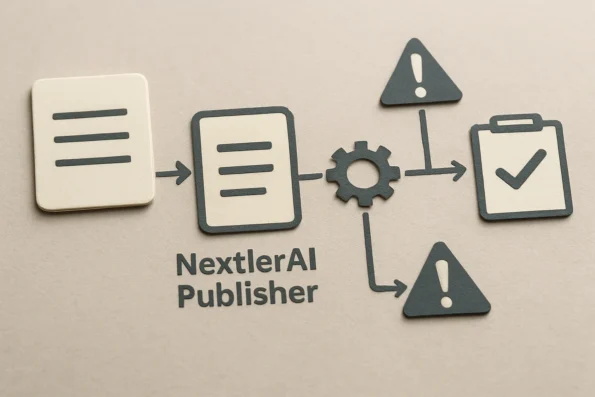
It is also important to acknowledge that automation, while streamlining workflow and reducing manual burdens, does not guarantee measurable improvements in SEO or content performance in isolation. The effectiveness of automated briefs still depends on the strategic quality of source materials, editorial oversight, and ongoing alignment with broader content goals. Publisher’s automation should therefore be seen as an enabler—never a replacement for critical, context-aware human judgment.
Editorial Governance Mechanisms and Decision Boundaries
Within NextlerAI Publisher, editorial automation is designed to function as a controlled subsystem within your larger workflow. Approval checkpoints are not merely procedural—they are enforceable boundaries set by role permissions. Only users with designated authority can advance, amend, or publish briefs, and these actions are fully logged for future audit. The configuration of these permissions should reflect your existing editorial hierarchy and escalation routes, ensuring that sensitive or high-risk briefs always pass through appropriate levels of scrutiny.
Additionally, while Publisher can be configured to generate briefs in bulk or on a schedule, these triggers do not override the need for ongoing editorial dialogue. When business objectives or search intent priorities change suddenly, manual intervention is the only safeguard against misaligned automation output. Editorial teams must periodically review automation rules and inventory sources to ensure continued alignment.
Publisher’s rule-based quality controls are customizable at the organization or project level. Teams should calibrate which quality warnings trigger mandatory review and which are informational, based on their own standards. For example, a warning about missing metadata may be a hard blocker, whereas a style suggestion could be set as non-critical. This flexibility allows teams to tailor automation to their operational risk tolerance.
Finally, it is essential to establish explicit accountability for interpreting and acting on Publisher’s automated reports. Document who is responsible for resolving flagged issues and under what circumstances exceptions can be made. This prevents ambiguity and ensures that automation supports, rather than undermines, editorial standards.
For a detailed breakdown of how Publisher enforces approvals, manages scheduling boundaries, and maintains consistency within editorial workflows, consult the referenced article on AI editorial workflow automation at NextlerAI’s official blog. This resource provides stepwise guidance on integrating automation with robust governance, offering actionable insights for teams scaling their editorial production.
Checklist: Launching Your Automated Content Brief Pipeline
For a reliable and controlled rollout of automated content brief generation in Publisher, each checklist item below addresses a unique technical, editorial, or workflow constraint. Implement these mechanisms to ensure every generated brief aligns with your brand and governance requirements while minimizing operational risk. Leveraging editorial calendar automation with NextlerAI Publisher helps align content brief scheduling and assignment, ensuring every draft fits within your publication plan and workflow boundaries. [2001.03625] Stratified disc wind models for the AGN documents the relevant background and implementation boundaries.
- Configure Brand Voice and Editorial Boundaries: In Publisher’s content settings, explicitly define tone, prohibited phrases, and editorial do’s and don’ts. These system instructions act as guardrails, automatically propagating to each new brief and preventing drift from brand standards. (nextlerai.com)
- Set Content Length and Section Requirements: Specify minimum/maximum word counts and enforce mandatory sections (such as introductions or conclusions) for every brief template. This constraint helps ensure each brief is structurally compliant before it enters editorial review.
- Enable Topic Management to Prevent Duplication: Activate Publisher’s topic management features to restrict generation of briefs for overlapping topics or keywords. This mechanism blocks the creation of near-duplicate articles by referencing your live editorial inventory.
- Assign Approval Roles and Mandatory Review Steps: Define which editorial roles can approve, revise, or publish briefs. Publisher’s permission system allows you to enforce explicit manual checkpoints, ensuring only authorized users advance briefs through the pipeline.
- Test on Draft-Only Mode: Activate draft-only brief generation to isolate and debug template logic, section rendering, and compliance with structural settings before enabling automated publication. Monitor for formatting anomalies or missing required fields in a risk-free environment.
- Validate SEO Metadata Integration: Confirm that brief templates in Publisher generate all required SEO metadata fields and that these are correctly output for your SEO plugin’s consumption. Inspect metadata hand-off to verify compliance with indexing requirements.
- Audit Publisher Content Settings for Full Coverage: After initial setup, systematically review all Publisher content settings—ensuring every configuration reflects your evolving editorial policies and technical constraints as documented in the Publisher Content Settings Guide.
- Synchronize User Permissions with Editorial Policy: Double-check that all user accounts within Publisher have permissions mapped precisely to their real-world editorial responsibilities. This includes validating who can generate, approve, edit, or publish briefs, and ensuring no escalation or bypass loopholes exist that could allow unauthorized changes.
- Integrate with Version Control and Backup Procedures: Confirm that every generated brief is captured by your versioning and backup solutions. Ensure Publisher’s output is compatible with your organization’s existing disaster recovery and rollback protocols, so that automated changes never compromise editorial continuity or traceability.
- Verify Automation Triggers and Scheduling Alignment: Review Publisher’s integration with your WordPress instance to confirm that automation triggers (such as scheduled brief generation or workflow transitions) are aligned with your editorial calendar and do not conflict with manual publishing events or third-party plugins.
- Review Template Variable Mapping and Data Sources: Audit every template to ensure variables pulling data (such as keywords, target audience, or contextual notes) are mapped to accurate, up-to-date sources within Publisher. This protects against outdated or irrelevant information propagating through automated briefs and supports higher editorial precision.
- Document Exception Handling Procedures: Establish and record explicit procedures for handling brief generation failures, malformed output, or system downtimes. Assign responsibility for monitoring automation logs and responding to templating or scheduling errors, so that operational gaps are closed before full launch.
This checklist, when followed in Publisher, establishes enforceable boundaries and technical safeguards for automated content brief generation. Each mechanism is designed to support a scalable, auditable pipeline without repeating manual tasks or introducing workflow ambiguity. Mastery of these controls is essential before moving on to more advanced, multi-topic automation scenarios.
Illustrative Scenario: Multi-Topic Brief Generation in Action
Illustrative scenario: Consider a digital publishing team preparing a campaign targeting several overlapping keyword groups within a competitive niche. The objective is to rapidly deploy a series of SEO-optimized, editorially consistent articles without risking duplication or cannibalization. The team turns to NextlerAI Publisher to orchestrate the process. When evaluating risk controls for content automation, it’s valuable to compare how leading AI workflow automation tools enforce permissions, approvals, and inventory safeguards in real-world publishing environments. [2103.15372] Sobolev space theory and Hölder estimates for documents the relevant background and implementation boundaries.
Coordinated Multi-Topic Planning
The content lead initiates the process using Publisher’s Topic Manager. By importing a curated keyword set and associated source materials, Topic Manager automatically inventories potential articles, scoring each for thematic uniqueness. The system flags any near-duplicates and queues only those briefs that add material value to the portfolio, ensuring a clear delineation between topics.
Behind the scenes, Topic Manager evaluates keywords and proposed titles against the existing inventory. It references previous articles and their metadata, leveraging internal logic to highlight risk areas—such as overly broad topics, high similarity, or content that may conflict with current editorial objectives. Editors can set threshold criteria for what constitutes ‘too similar,’ tuning the system to the team’s risk tolerance and strategic priorities. Each queued article is documented with its rationale and relationship to other topics, supporting decision-making and future audits. Read more on Topic Manager and smart strategy.
Editorial Safeguards and Approval Gates
Before briefs move forward, editors set explicit approval checkpoints. Publisher requires that each generated brief is reviewed for brand alignment, editorial tone, and compliance with internal guidelines. If a brief fails to meet any requirement—such as section structure or SEO metadata completeness—it is held at the checkpoint for revision. This maintains quality and prevents unauthorized content from entering the pipeline.
These approval gates are configurable, allowing teams to require additional review steps for sensitive or high-impact topics. Permissions are mapped to individual editorial roles, ensuring only authorized users can advance, edit, or reject briefs. Each action is logged, providing a transparent audit trail for accountability and compliance. Editors can append contextual notes to briefs at any checkpoint, clarifying rationale or requesting specific changes, which remain attached as documentation for downstream contributors.
Automated Slot Reservation and Scheduling
Once briefs are cleared, Publisher’s workflow leverages native WordPress scheduling to reserve publication slots. The system ensures that no two related articles are scheduled in proximity that could harm search visibility or editorial cadence. Slot conflicts or eligibility issues are flagged before final approval, allowing strategic adjustments without manual calendar edits.
This automated scheduling is tightly integrated with the topic inventory, recognizing dependencies and sequencing requirements. Publisher cross-references the planned publication dates against availability, holding back briefs if a suitable slot cannot be secured. This mechanism supports both recurring content releases and one-off campaigns, adapting to the editorial calendar while preventing bottlenecks or overlap. All scheduling actions are synchronized with WordPress’s own publishing controls for operational reliability.
Structured, Non-Overlapping Content Pipeline
With Topic Manager and editorial controls in place, the team achieves a pipeline where every brief is assigned a unique topic, scheduled to publish without overlap, and directly aligned with the brand’s content strategy. Contextual documentation is attached to each topic, providing clarity for complex or evolving editorial requirements. Inventory and strategy records remain auditable throughout, enabling retrospective analysis and compliance checks.

In cases where topics evolve or new priorities emerge, editors can revisit and re-score queued briefs, ensuring the pipeline remains responsive yet controlled. The combination of documentation, audit trails, and inventory management positions the team to demonstrate governance and adapt strategically, even as the content landscape shifts.
Scenario Summary
This scenario demonstrates how NextlerAI Publisher’s integrated topic management, editorial approval controls, and automated scheduling combine to deliver a scalable, risk-controlled workflow for multi-topic brief generation. Every mechanism—from queueing to approval gates, scheduling, and documentation—serves a distinct function in upholding editorial standards and SEO integrity across a dynamic content operation.
Risk-Control Table: Safeguarding Editorial and SEO Quality
Automating content brief generation with NextlerAI Publisher requires clear governance to prevent editorial, SEO, and operational failures. As automated workflows scale, even small process lapses can propagate, amplifying risks to brand consistency, search visibility, and content integrity. NextlerAI Publisher addresses these challenges by embedding multi-layered controls at key points in the briefing and publishing pipeline. For organizations with advanced requirements, a NextlerAI custom API integration can extend automated content briefing workflows while maintaining strict security and eligibility boundaries.
Publisher’s inventory and cannibalisation checks operate by scanning the current repository of published and in-progress articles, matching target topics and keyword clusters against proposed briefs. This mechanism can block generation or flag high-risk overlaps, reducing the risk of duplicate content and internal competition. These scans rely on structured metadata and topic mappings maintained within Publisher, allowing for near real-time analysis as new briefs are queued. Editorial teams retain decision-making authority to override or refine flagged briefs, ensuring automation does not bypass human judgment. For brand and compliance risks, Publisher enforces role-based approval gates and brand voice configuration. Each brief must be explicitly reviewed by assigned roles before advancing, with style and tone parameters checked at every checkpoint.
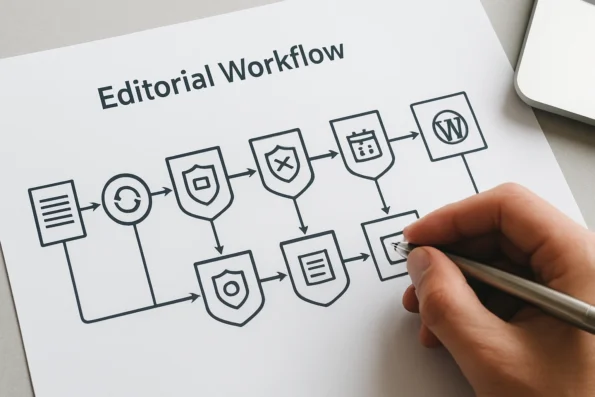
Scheduling conflicts—a common source of operational disruption—are managed through WordPress-native slot reservation. Publisher integrates with WordPress scheduling to reserve publication slots, preventing unintentional overwrites or missed deadlines. This mechanism includes verification of both reserved times and publishing users, ensuring that only one scheduled brief can occupy a slot at a given time or within a defined window. Automated metadata injection addresses SEO risks by mandating that required fields (such as title, meta description, and focus keywords) are populated and validated before briefs proceed to production or handoff to the active SEO plugin. Metadata validation is performed at each workflow stage where editing or automated updates occur, ensuring continuity and preventing accidental omissions. Finally, versioning and audit logs record all substantive changes to briefs and metadata, supporting accountability, rollback, and regulatory compliance. These logs not only track the user and timestamp for every modification, but also allow administrators to review change histories and enforce retention policies as required by organizational protocols.
| Risk | Control Mechanism in Publisher | Operational Scope | Reference |
|---|---|---|---|
| Duplicate or overlapping briefs | Inventory and cannibalisation checks | Scan existing inventory before brief generation; block or warn on overlap | Publisher documentation |
| Unapproved or off-brand content | Role-based approvals and brand voice configuration | Require explicit review and enforce style parameters at each checkpoint | Publisher product details |
| Publication scheduling conflicts | WordPress-native slot reservation | Reserve and verify unique publication times to prevent clashes | Publisher CMS integration guide |
| SEO metadata omissions | Automated metadata injection and validation | Populate, verify, and hand off metadata to active SEO plugin during workflow | Publisher product details |
| Untracked content changes | Versioning and review logs | Record all modifications for audit and rollback purposes | Publisher dashboard documentation |
By structuring risk controls directly within the automation pipeline, NextlerAI Publisher limits exposure to the most common editorial and SEO pitfalls. Each control is configurable to reflect the organization’s risk tolerance and governance standards. These mechanisms extend to integration touchpoints, such as third-party workflow tools or SEO plugins, ensuring that all stages of automated content briefing are protected by enforceable safeguards. For implementation specifics on inventory scanning and cannibalisation prevention, consult the official inventory and cannibalisation control documentation. The next section defines key terms within this automated workflow.
Definitions: Key Terms in NextlerAI Automated Briefing
Precision in terminology is essential for effective workflow management in automated content briefing. NextlerAI Publisher employs a set of clearly defined terms to support transparency, compliance, and operational clarity throughout the content brief automation lifecycle. Understanding these terms ensures all team members interpret workflow stages and controls consistently. Each definition below reflects the explicit mechanisms and responsibilities managed by Publisher during automated briefing, supporting governance and operational alignment. A thorough NextlerAI Publisher CMS integration is essential for automating content briefs within a WordPress environment, ensuring structured data flow, role-based controls, and reliable editorial checkpoints.
Brief
A brief in NextlerAI Publisher is a structured document that outlines the intended article’s topic, section hierarchy, required metadata, and any editorial notes or compliance flags. Each brief serves as both a roadmap for content creators and a compliance artifact for editorial review, maintaining alignment with brand and SEO standards. The brief template within Publisher supports variable fields, enabling editorial teams to specify required sections, data types, and mandatory compliance checks. Once generated, a brief acts as a living document: any subsequent edits or approvals are logged, supporting audit trails and real-time content governance.
Topic Manager
The Topic Manager is the core Publisher feature for overseeing topics at every stage of the content pipeline. It manages topic assignments, tracks progress, detects near-duplicates, and enforces pipeline flow rules. Topic Manager leverages structured topic mapping and keyword analysis to flag overlaps before a brief is finalized. Editors can reprioritize, merge, or exclude topics in response to inventory or strategic shifts. This ensures that each article brief is unique, aligned with editorial priorities, and avoids keyword cannibalization before proceeding to scheduling or production.
Approval Checkpoint
An approval checkpoint is a mandatory human review step embedded in the automated workflow. At these points, designated editorial staff must review, edit, or approve content briefs before automation advances. Publisher allows teams to assign distinct approval roles and configure checkpoint placement within the workflow. Approval checkpoints are critical for enforcing oversight and maintaining content integrity, as automation will not bypass these gates without explicit authorization. All actions at checkpoints are recorded by Publisher’s audit system, supporting compliance and traceability.
Slot
A slot refers to a specific, reserved publication time managed directly via WordPress scheduling. Publisher integrates with the native WordPress scheduler to allocate these slots, ensuring that each brief or article enters the publishing queue without conflicting with other scheduled content. Slot reservation is handled with explicit lock and release actions, preventing double-booking and enabling coordinated, conflict-free release cycles. Slots can be pre-assigned during the planning stage or dynamically allocated as briefs move through approval checkpoints.
Inventory Control
Inventory control within Publisher is the process of checking the existing content repository for potential overlaps, near-duplicates, or cannibalization issues. This mechanism operates before new briefs are finalized, using structured topic and metadata mapping to protect both SEO value and editorial diversity. Inventory control includes automated scanning of published and draft content, flagging any conflicts for editorial review. This process is triggered at key workflow points—such as during topic assignment and prior to brief approval—ensuring sustainable content growth and minimizing internal competition between articles.
SEO Metadata
SEO metadata includes the title, meta description, and keyword fields that Publisher generates and maintains as part of each brief. These fields are structured to meet both search engine requirements and editorial standards, with templates ensuring consistency across briefs. Publisher ensures this metadata is correctly injected and handed off to the active SEO plugin, supporting downstream optimization and discoverability. Metadata can be edited at approval checkpoints and changes are logged for compliance. Technical specifications and integration details for metadata handling, as well as internal link generation processes, are available in the Publisher’s SEO metadata and internal links documentation.
FAQ
What are the practical steps for auditing your workflow before automating content briefs with NextlerAI Publisher?
Begin by identifying all source materials your team intends to use. Map your current editorial roles to Publisher’s permission structure and verify that each step aligns with your editorial policy. Assess your existing topic inventory for overlap or content gaps using Publisher’s inventory features. Confirm that your WordPress scheduling and backup systems are configured to handle automation without disruption, and ensure your version control protocols cover automated briefs.
Which expert cautions should editorial teams consider when shifting to automated brief generation?
Editorial teams should maintain human oversight at approval checkpoints, as automation does not replace editorial judgment. Automated briefs will not adapt to sudden editorial or business changes unless manual intervention is planned. Role permissions should be reviewed to prevent unauthorized modifications, and quality warnings must be carefully interpreted—distinguishing true publication blockers from informational flags.
What is the essential checklist for launching automated content briefs with Publisher?
Your checklist should include defining brand voice and editorial boundaries, specifying content structure and metadata, activating topic management controls to avoid duplication, enabling explicit approval roles, and validating SEO metadata hand-off processes. Test your brief generation in a draft mode before publishing, and synchronize all permission settings with your editorial workflow and backup systems.
How does automated brief generation operate in a multi-topic scenario?
In a multi-topic scenario, Publisher’s Topic Manager scores and queues articles based on their relevance and overlap, ensuring each brief is distinct. Editorial approval gates are configured so only briefs that align with strategy proceed to scheduling. WordPress-native scheduling reserves publication slots, avoiding content collisions and ensuring a controlled pipeline, even as topics vary or overlap.
What are the key risks and control measures in automated content briefing workflows?
Key risks include duplicate content, unauthorized changes, scheduling conflicts, missing SEO metadata, and untracked changes. Publisher addresses these through inventory and cannibalisation checks, role-based approvals, WordPress-native slot management, automated metadata validation, and versioned audit logs. Each control operates at a defined workflow stage to enforce compliance and traceability.
Which definitions clarify the roles and boundaries in NextlerAI’s automated briefing process?
Critical definitions include the “brief” as a structured article plan, “Topic Manager” for pipeline oversight, “approval checkpoint” for enforced human review, “slot” as a reserved publication time, “inventory control” to monitor for content overlap, and “SEO metadata” as the structured fields passed to your SEO plugin. These terms define operational boundaries within Publisher’s automation.
Conclusion
Automating content brief generation with NextlerAI Publisher offers structured efficiency while maintaining critical editorial and SEO safeguards. The platform’s inventory and topic controls, versioned audit trails, and permission-based checkpoints enable you to confidently scale content planning without sacrificing oversight. This approach ensures each brief is unique, compliant, and fully documented within your editorial workflow.
Underlying these benefits is a system of granular controls: Publisher enforces role-based permissions at each checkpoint, requiring explicit human sign-off before automation proceeds. Topic Manager continuously references your content inventory to prevent thematic overlap, while integrated audit logs record every action—mapping responsibility to individual users for traceability and accountability. Inventory controls and scheduling logic interact with WordPress to maintain a conflict-free publication pipeline, and version control mechanisms provide a robust safety net for rollback or compliance review. These mechanisms, all governed through configuration screens, allow editorial and technical leads to implement organizational policies with precision, ensuring automation enhances rather than disrupts established processes.
At a deeper level, Publisher’s configuration ecosystem requires ongoing coordination between editorial and technical roles. Decisions about role assignments, content inventory scope, and approval checkpoint placement directly influence how automation behaves within your workflow. By mapping these elements to Publisher’s permission model, you anchor automation within your established governance framework, reducing the likelihood of unintended publishing or quality errors. The audit trail infrastructure not only provides accountability, but also supports post-publication analysis and regulatory compliance, as every action is timestamped and attributable. This end-to-end visibility is essential for organizations with strict editorial standards or external audit requirements.
To advance, assemble your editorial and technical leads for a walkthrough of Publisher’s configuration screens. Validate that all permission roles, inventory rules, and approval flows mirror your established policy. This focused session will reveal any misalignments between your intended governance and Publisher’s actual automation boundaries, enabling a smooth transition to reliable, governed brief automation.