







Introduction
AI workflow automation for content is redefining how organizations plan, create, review, and publish at scale. For content managers, editorial leads, and digital marketing professionals, these automation tools offer tangible solutions to recurring challenges: manual bottlenecks, inconsistent quality, and limited team capacity. By embedding intelligent automation directly into content operations, teams can accelerate production, enforce consistency, and allocate resources more strategically.
Modern platforms such as NextlerAI Publisher enable businesses to automate the transformation of diverse source material into structured, review-ready content within WordPress workflows—without sacrificing oversight or editorial control. This approach reduces manual errors, supports scalable content output, and provides detailed audit trails for every action, making it easier to maintain governance and quality across teams of any size.
Automation works by orchestrating distinct workflow stages through configurable rules and integrations. For example, automated topic assignment, content formatting, and calendar scheduling streamline repetitive tasks, while built-in approval gates ensure that editors can intervene at critical decision points. NextlerAI Publisher offers native compatibility with WordPress scheduling and approval features, allowing organizations to retain granular editorial control while benefiting from automated throughput. Content teams can also leverage audit logs to trace every content change, providing transparency for both compliance purposes and continuous process improvement. By shifting decision-making for routine actions to the workflow engine, human oversight can focus on strategic review, policy enforcement, and creative quality.
Ultimately, AI-powered content workflow automation enables teams to address both operational and commercial priorities. It delivers measurable improvements in efficiency and team collaboration, while supporting essential safeguards for compliance and brand integrity. By the end of this guide, you will understand not only the mechanisms and benefits of content workflow automation, but also the concrete steps, decision points, and governance practices required to implement these systems safely and effectively in your organization.
- Key takeaways: What AI workflow automation delivers at each content stage
- Comparison table: Approaches to AI workflow automation for content
- Actionable how-to steps: Implementing AI workflow automation for content
- Pros and cons: Commercial benefits and risks of automating content workflows
- Implementation notes: Real-world integration and oversight
- Checklist: Ensuring a safe and effective rollout
- FAQ
- Conclusion
Key takeaways: What AI workflow automation delivers at each content stage
AI workflow automation for content operations unlocks targeted improvements at every step of the content lifecycle. Rather than a blanket solution, automation mechanisms are designed to address distinct bottlenecks in planning, creation, review, and publishing. This modularity ensures teams can fine-tune automation to fit actual operational needs and oversight requirements, supporting both small editorial teams and complex, multi-role environments. To compare the best AI workflow automation tools and their feature sets, see the best AI workflow automation tools.
Planning: Streamlined prioritization and topic management
In the planning phase, AI-driven automation tools systematically evaluate proposed topics, assign priority based on strategic criteria, and sequence assignments to match resource availability. Such tools can reference audience data, content performance metrics, and custom editorial guidelines to inform prioritization. This reduces the manual overhead of maintaining editorial calendars and prevents content gaps or redundancies, as highlighted in peer-reviewed studies of digital content management workflows (IEEE, MDPI). Additionally, automated notifications facilitate timely assignment of topics to the right contributors, minimizing delays from missed communications.
Creation: Structured transformation with reduced manual error
Advanced platforms such as NextlerAI Publisher automate the transformation of raw source material into structured, review-ready drafts. These mechanisms ingest unstructured data, apply predefined templates, and output content that adheres to brand voice and format standards. This accelerates content throughput and minimizes the risk of human error in data transfer or formatting. The automation can also enrich drafts with metadata or suggested headlines, further reducing repetitive manual work. However, editorial checkpoints remain essential, ensuring that creative nuance and regulatory requirements are met—especially critical in regulated sectors or where subject-matter accuracy is non-negotiable.

Review: Transparent approvals and audit trails
Editorial workflow automation introduces configurable review and approval gates, allowing teams to enforce standards and capture each action within a transparent audit log. Actions such as edits, comments, and sign-offs are automatically recorded, supporting efficient team handoffs and enabling detailed post-publication audits. Detailed audit trails facilitate compliance checks and retrospective analysis, which are valuable for regulated industries or organizations subject to external review. Automation also supports role-based access, ensuring that only authorized personnel can approve or modify content at each stage.
Publishing: Reliable scheduling and minimized manual intervention
Automated scheduling tools reduce the burden of calendar management, enabling content to be published precisely on schedule without last-minute oversight. Especially when integrated with platforms like WordPress, automation mechanisms can queue posts, handle embargoes, and trigger releases across multiple channels. This ensures that releases are timely and consistent, regardless of time zones or staff availability. Automated publishing mechanisms can also support fallback options, such as holding publication if required approvals are not met, adding an extra layer of editorial protection.
Commercial and operational impacts
By selectively automating each stage, organizations realize faster throughput, more predictable delivery, and the ability to scale output without proportional increases in headcount or process risk. Workflow automation logs every action, providing teams with the transparency and data needed for continuous improvement, defensible audit trails, and informed process optimization. These mechanisms help organizations maintain consistent standards, streamline handoffs, and focus human expertise on high-value creative and strategic work.
Comparison table: Approaches to AI workflow automation for content
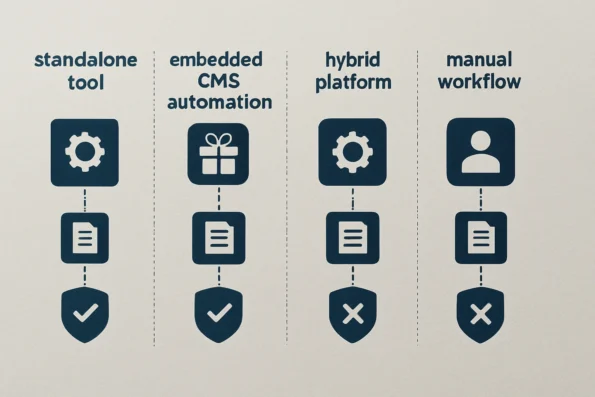
Organizations evaluating AI workflow automation for content must weigh integration depth, editorial controls, and risk governance capabilities. The table below distinguishes three main approaches—standalone automation tools, embedded CMS automation, and hybrid orchestration—across the key phases of content operations. This structured comparison supports practical decision-making, highlighting where governance and compatibility become critical for regulated sectors or multi-team environments. All capabilities are drawn directly from verified product documentation and published research, with regulatory context included where appropriate. For more on editorial workflow automation in practice, including scheduling and consistency, review this dedicated guide.
| Approach | Integration Depth | Editorial Controls | Risk & Compliance Governance | Best Use Cases | Source |
|---|---|---|---|---|---|
| Standalone Automation Tools | External to CMS; connects via API or export/import | Basic rule-based triggers; limited multi-stage approvals | Minimal built-in audit trails; relies on manual oversight for compliance | Simple topic assignment, recurring scheduling, rapid prototyping | MDPI Information |
| Embedded CMS Automation | Native to platform (e.g., WordPress plugin); direct access to content inventory | Granular approval gates, configurable checkpoints, audit logs (e.g., NextlerAI Publisher) | Supports auditability, role-based controls, and compliance workflows; suitable for regulated teams | End-to-end editorial pipelines, structured content transformation, transparent scheduling | NextlerAI Blog |
| Hybrid Orchestration Platforms | Middleware connects multiple systems (CMS, DAM, messaging) | Conditional logic; possible integration of both manual and automated approvals | Customizable governance layers; dependent on configuration and third-party compliance modules | Complex, multi-channel workflows spanning several departments or platforms | Box Blog |
| Manual Editorial Workflow | No automation; human-driven in CMS or shared documents | Full human review and sign-off at all stages | Clear but labor-intensive auditability; high risk of bottlenecks and inconsistency | Small teams, high-sensitivity publications, or legacy environments | IEEE Xplore |
| Regulatory Compliance (EU AI Act, NIST RMF) | Dependent on tool; must ensure traceability and human-in-the-loop for high-risk content | Enforceable via multi-stage approvals and audit logs in compliant platforms | Obligations for deployers: maintain documentation, allow for intervention, and assess risk regularly | Financial, healthcare, and public sector content automation | EU AI Act / NIST |
The table demonstrates how each approach to content workflow automation introduces distinct trade-offs that affect both operational agility and governance strength. Standalone automation tools can be rapidly deployed alongside existing systems but frequently lack the depth of audit trails and approval granularity required in regulated or multi-stage editorial processes. Embedded CMS automation, such as solutions integrated directly into WordPress (e.g., NextlerAI Publisher), allows for robust content inventory access, fine-tuned approval gates, and structured auditability, aligning well with organizations that require consistent compliance and transparency. Hybrid orchestration platforms provide flexibility across multiple tools and content repositories, but effective governance depends heavily on custom configuration and the integration of external compliance modules. Manual workflows, while offering total human oversight, often struggle with scaling, speed, and consistency, making them suitable mainly for specialized or low-volume publishing. Jurisdiction-specific regulations such as the EU AI Act and NIST RMF emphasize the need for traceable, human-in-the-loop processes, enforceable only when platforms are equipped with documentation and intervention capabilities.
Implementation choices should also consider the nuanced mechanisms that determine how automation integrates with existing editorial policies and technical stacks. For example, embedded CMS automation often leverages native scheduling APIs, structured content metadata, and role-based permission layers to facilitate detailed audit logs and automated escalation paths. In contrast, hybrid orchestration platforms may require custom connectors and mapping rules to ensure data consistency across disparate repositories, increasing both flexibility and complexity. Editorial control is not just about approvals—it involves configuring escalation routes, exception handling, and integrating human-in-the-loop checkpoints at critical junctures, which is more straightforward when automation is native to the CMS. The interplay between automation depth and control granularity becomes especially significant in regulated settings, where compliance workflows must provide tamper-evident logs, regular risk assessments, and the ability for authorized intervention. Selecting an approach should be based on integration with current systems, the desired level of editorial control, support for compliance, and the complexity of your operational environment. For implementation details and next steps, see the following section.
Actionable how-to steps: Implementing AI workflow automation for content
Successfully deploying AI workflow automation for content demands a disciplined, stepwise approach. Each phase builds on the previous, ensuring that automation is mapped precisely to your team’s real processes and that governance is maintained. Here is a pragmatic roadmap for introducing automation into your content operations, from initial mapping through continuous refinement. AI Act | Shaping Europe’s digital future documents the relevant background and implementation boundaries.
-
Map your current content workflow in detail.
Document every stage of your content process—from initial planning through drafting, review, approvals, and publishing. Pay close attention to hand-off points between roles, as these are often the source of manual delays and errors. Identify which transitions require human judgment and which tasks are purely administrative or repetitive. Use visual workflow diagrams or collaborative documentation to surface bottlenecks and clarify dependencies. This step creates the foundation for targeted automation and helps define where human oversight must remain central versus where routine work can be streamlined.
-
Select automation solutions suited to your CMS and team structure.
Assess available workflow automation platforms for their compatibility with your content management system, editorial structure, and compliance needs. For WordPress-centric teams, consider solutions like NextlerAI Publisher, which supports end-to-end editorial pipelines within familiar environments and provides structured automation for recurring content tasks (nextlerai.com). Evaluate the availability of granular permission settings, audit trails, and the ability to customize workflow states. Choose platforms that allow integration with your existing authentication, metadata, or asset management tools to maintain workflow continuity and minimize disruption during rollout.
-
Configure source material ingestion and content transformation.
Set up your chosen tool to accept, inventory, and process source materials—such as briefs, outlines, or external feeds. With NextlerAI Publisher, for example, you can automate the transformation of incoming material into review-ready drafts, mapping input fields to structured content blocks as required by your editorial process (step-by-step guide). Define triggers for ingestion—such as new file uploads, scheduled imports, or API calls—and specify the taxonomy, tagging, or categorization rules that ensure content is routed correctly for review. Rigorous configuration at this stage reduces downstream friction and supports analytics or compliance reporting.
-
Establish automated review cycles, approvals, and publication slots.
Within your workflow tool, design multi-stage approval steps that align with your editorial policy. Assign clear responsibilities for each checkpoint and enable automated notifications for pending reviews. Use the platform’s scheduling features to allocate publication slots, reducing manual intervention and bottlenecks in the final stages of content release. NextlerAI Publisher supports configurable approval gates and scheduled publishing within WordPress, allowing teams to create repeatable, auditable workflows (setup guide). Ensure that escalation paths are documented for unresolved reviews, and that notifications are routed appropriately for time-sensitive content.
-
Monitor pipeline logs and refine automation rules continuously.
After launch, regularly audit the workflow’s activity logs to verify that content is moving as intended and that exceptions are flagged promptly. Most platforms provide detailed, tamper-evident logs for each automation action. Solicit feedback from all stakeholders, including editors and compliance officers, to spot recurring issues or edge cases. Adjust automation rules, hand-off criteria, and approval paths as team needs evolve, ensuring the workflow remains robust and transparent. Periodic review of automation performance supports continuous improvement and readiness for audits or scaling.
By following these steps, organizations can implement AI workflow automation for content with practical oversight, aligning automation depth to operational realities and editorial standards. The next section examines the commercial benefits and risks of automating content workflows, highlighting areas where human oversight remains essential.
Pros and cons: Commercial benefits and risks of automating content workflows
Automating content workflows with AI introduces significant operational and commercial advantages, but it also creates new oversight challenges that content leaders must address. Understanding the distinct benefits and risks is essential before scaling automation across your editorial pipeline. Explore automated content brief generation for insights into balancing scale and editorial control. AI Risk Management Framework | NIST documents the relevant background and implementation boundaries.
Commercial benefits: Efficiency, scalability, and consistency
AI-driven content workflow automation can sharply increase operational efficiency by minimizing the manual labor required for repetitive tasks. Automated systems transform bulk source material into structured content, streamline brief generation, and facilitate uniform formatting—reducing the risk of human error. Teams can manage a higher volume of content with fewer bottlenecks, enabling scalable output that remains aligned with predefined brand guidelines. In platforms like NextlerAI Publisher, automation mechanisms also enforce consistent editorial standards and support structured review cycles, helping maintain a cohesive brand voice across all published materials.
Consistency is further enhanced by programmed governance rules: each content piece follows the same set of approval and quality gates, reducing variability. This uniformity not only improves brand reliability but also frees senior editors for strategic oversight rather than routine compliance checks. Automated logs and action histories generated by workflow tools support auditability and enable teams to pinpoint areas for continuous process improvement.

Additionally, automation supports allocation of team resources by handling tedious or high-volume tasks, such as initial content drafting or bulk formatting. This allows skilled writers and editors to focus on creative strategy, narrative development, and adapting messaging to shifting market conditions. By reducing repetitive manual input, organizations can respond more quickly to content demands without sacrificing baseline quality or process transparency.
Risks: Editorial blind spots and integration complexity
Despite these advantages, content workflow automation also introduces risks requiring careful mitigation. A primary concern is reduced human oversight at critical quality checkpoints. Automated pipelines can miss subtle context, regulatory nuances, or evolving brand directions that human editors would catch. This is particularly relevant for compliance-sensitive industries or organizations with shifting editorial standards. Without periodic manual review, there is a risk of duplicate, off-brand, or non-compliant content progressing through the workflow unnoticed.
Integration complexity can also present commercial risks. Embedding automation into existing content management systems may require technical configuration, detailed rule mapping, and ongoing governance to prevent operational friction or unintended publishing errors. Organizations must ensure that every automation rule is documented, reviewed, and adaptable as editorial needs evolve.
There is also the possibility of process drift if governance rules are not regularly updated to reflect changes in brand positioning, compliance expectations, or organizational priorities. Automated workflows that are not periodically audited may gradually deviate from intended quality or compliance standards, especially in rapidly changing regulatory environments.
Governance and quality management: Where human oversight remains critical
Effective automation supports scale only when paired with transparent governance and defined intervention points. Automated systems should be configured to route exceptions—such as flagged content or unresolved review stages—to designated human stakeholders. Editorial managers must maintain clear escalation paths and retain authority over final approvals and publication. For example, while content briefs and draft materials may be generated automatically, human editors should still validate final outputs to safeguard against subtle compliance or reputational risks. This layered approach ensures operational gains do not come at the expense of quality or auditability.
In summary, the most successful automation implementations are those where decision boundaries are explicitly defined—routine, low-risk decisions are automated, while complex, subjective, or high-consequence approvals remain with human editors. This division of labor protects brand integrity and compliance while unlocking the efficiency and scalability benefits of AI-driven workflow automation. The next section addresses practical integration and oversight considerations for embedding these systems into live operations.
Implementation notes: Real-world integration and oversight
Embedding AI workflow automation for content into live operations requires precision and explicit alignment with your existing CMS and editorial standards. Before activating any automation, review your content management system’s technical constraints, supported APIs, and current editorial governance rules. This diligence ensures that automated workflows complement, rather than conflict with, core publishing requirements. When designing your AI workflow automation for content, understanding workflow automation triggers is essential for aligning automation with specific team structures and editorial checkpoints.
Aligning automation with CMS and editorial policy
Every automation rule must map clearly to your CMS functionality and editorial policy. When automating within WordPress, only enable features that your current version and plugin stack can support without disruption. For instance, NextlerAI Publisher builds on native WordPress scheduling, article state management, and approval workflows, ensuring that automated actions remain visible and reversible within standard editorial pipelines.
Leveraging native scheduling, approvals, and logging
Transparency in workflow automation is non-negotiable. Use your platform’s built-in scheduling, approval, and activity logging features to ensure every automated step is documented. NextlerAI Publisher, for example, integrates with WordPress Cron and approval queues, supporting granular oversight throughout the content lifecycle. This approach makes it feasible to track, audit, and intervene in automation sequences as business needs dictate.
Ongoing monitoring and error resolution
Regularly audit automation actions and outputs. Establish a routine for reviewing logs, flagging anomalies, and investigating failed automations. In practice, this might involve a weekly review of pipeline logs and a process for rapid escalation if content is published out of sequence or without approval. Such checks reduce the risk of unnoticed errors propagating downstream.
Rollback and recovery planning
Automation missteps are inevitable, so robust rollback and recovery protocols are essential. Confirm that your workflow solution—particularly when integrated with WordPress—supports draft restoration, scheduled post cancellation, and the ability to halt automation sequences mid-stream if conflicts or compliance issues arise. Document these procedures and test them periodically to ensure operational resilience under real-world conditions.
Checklist: Ensuring a safe and effective rollout
An effective transition to AI workflow automation for content depends on robust governance and staged implementation. Use this checklist to support operational continuity, mitigate risk, and build confidence across your team as you introduce automation into your editorial workflows. Each item is grounded in published best practices and platform documentation, reflecting the operational realities of digital content teams.

- Back up all existing workflows and digital content before implementing any automation mechanism. This minimizes the risk of data loss and ensures a reliable fallback should integration or testing issues arise. For WordPress users, leverage the platform’s built-in export and backup tools, or use dedicated backup plugins prior to enabling automation plugins. This is especially important when migrating to a new publishing system or integrating tools such as NextlerAI Publisher (nextlerai.com).
- Pilot automation with a limited subset of content or a small team to evaluate real-world outcomes. Restricting the initial rollout allows you to identify integration issues, content quality risks, or workflow gaps without affecting your entire operation. Define explicit criteria for pilot success, such as error rates, cycle time improvements, or adherence to editorial standards. Document all pilot findings to inform the broader rollout.
- Establish quality and approval checkpoints at all critical stages of the automated pipeline. Use platform-native controls to define required human reviews, ensuring compliance and brand standards are enforced before automated publication or scheduling. In platforms like NextlerAI Publisher, configure approval gates for each workflow stage and use scheduled publication features that respect these checkpoints (nextlerai.com).
- Document every automation rule, trigger, and escalation path for errors. Comprehensive documentation enables swift troubleshooting, clarifies accountability, and supports regulatory requirements for auditability—especially in environments handling sensitive or regulated content. Maintain a living register of automation logic, responsible parties, and escalation protocols for unresolved issues. For WordPress-based automation, this can be achieved via workflow plugin documentation fields and shared team wikis.
- Continuously review pipeline logs, output quality, and team feedback to refine automation rules. Regular review cycles make it possible to detect emerging workflow issues, adapt to editorial needs, and maintain alignment with business objectives as your automation scales. Use built-in logging and reporting tools to identify failure points, workflow delays, or compliance exceptions. Schedule feedback sessions with editorial and technical teams to ensure that automation outcomes remain aligned with evolving standards and stakeholder expectations.
- Monitor scheduled automation events and verify calendar alignment. For content operations dependent on strict timing (e.g., time-sensitive campaigns), confirm that automation is synchronized with editorial calendars and that publication slots are correctly configured. Platforms with native scheduling—such as WordPress with NextlerAI Publisher—allow you to audit upcoming events and adjust queues as needed. This helps prevent missed launches and supports reliable campaign delivery.
- Validate rollback and recovery procedures before scaling automation. Test your ability to recover draft content, unschedule posts, or revert automation-triggered changes. This ensures operational resilience if unexpected workflow issues, plugin conflicts, or data inconsistencies occur post-automation. Maintain clear documentation of rollback steps and ensure responsible team members have access and training for these procedures.
Following these controls is critical for organizations migrating from manual or semi-automated editorial processes to structured AI-powered automation. Each step reflects published guidance from platform providers and risk management best practices for digital content operations. As you complete this checklist, you establish a foundation for safe scaling and confident integration of AI workflow automation into your publishing environment. Next: see the FAQ for answers to common rollout and governance questions.
FAQ
How does AI workflow automation benefit each phase of content operations?
AI workflow automation accelerates and standardizes each content phase by automating structured steps: topic management in planning, draft transformation in creation, multi-stage checkpoints in review, and error-resistant scheduling in publishing. This division reduces bottlenecks and manual errors, ensuring consistent output and freeing specialists to focus on tasks that require human judgment. At the technical level, automation tools can assign topics based on pre-defined rules or real-time data, generate drafts using templated logic, and route content through configurable review chains. These mechanisms mean that each phase receives tailored automation, allowing teams to track progress and intervene only when escalation is warranted.
What are the key differences between leading AI content workflow tools?
Leading tools diverge in integration depth, editorial controls, and governance features. For example, some embed directly into CMS platforms to support granular review cycles and audit trails, while others act as external orchestrators with broad automation but less native oversight. The right fit depends on your team’s need for transparency, compliance, and integration with existing editorial policies. Embedded solutions, such as those with native WordPress integration, often offer structured scheduling, role-based approvals, and comprehensive logs, while standalone orchestrators focus more on multi-channel publishing and external workflow triggers. The implementation decision typically revolves around technical compatibility, desired oversight granularity, and the ability to integrate with your existing publishing environment.
What practical steps can a business follow to implement AI workflow automation?
Key practical steps include mapping all current workflows, choosing automation platforms compatible with your CMS, configuring ingestion and transformation rules, establishing clearly defined review stages, and enabling audit trails. Ongoing monitoring and refinement of automation logic are required to maintain quality and compliance as needs evolve. Decision-makers must document each manual step, identify error-prone transitions, and select tools that provide structured outputs and configurable approval workflows. Implementation should also include establishing version control, setting up scheduled publishing windows, and assigning clear escalation paths for unresolved issues. Technical teams should create detailed runbooks mapping automation actions to editorial policies, ensuring transparency and operational resilience.
What are the main pros and cons of automating content workflows with AI?
Automation delivers efficiency gains, scalability, and reduced manual oversight, but may introduce risks such as diminished human review, content duplication, and integration complexity. Mitigating these drawbacks requires built-in checkpoints, regular audits, and clear escalation paths to ensure that automation supports rather than overrides editorial standards. On the benefit side, process automation enables teams to handle higher content volumes with consistent structure and formatting, supports auditability through logged actions, and frees editorial resources for strategic review. However, without robust governance, automation can propagate errors at scale, so it is essential that organizations maintain a balance between automated throughput and human quality control, particularly for regulated or high-sensitivity content.
What implementation notes and checklist steps help ensure a safe rollout?
To ensure a safe rollout, back up workflows and content, pilot automation in a controlled environment, document all automation and escalation rules, configure mandatory quality checkpoints, and routinely review logs and outputs. Establishing rollback protocols and regular audits further protects operational integrity during and after implementation. Teams should align automation with existing editorial policies and technical infrastructure, use native approval and scheduling features where available, and track every automated action in audit logs. Ensuring that rollback mechanisms—such as draft restoration and scheduled post cancellation—are available in your chosen platform provides a safety net against workflow errors or misconfigurations. Finally, continuous feedback loops with stakeholders ensure that automation remains aligned with organizational quality and compliance standards as requirements evolve.
Conclusion
Implementing AI workflow automation for content is no longer a conceptual advance—it’s a practical necessity for content teams seeking to scale output, reduce manual bottlenecks, and ensure consistent governance across editorial operations. Verified tools, such as NextlerAI Publisher, now offer structured, stage-based automation that integrates directly with leading content management systems. This approach enables organizations to reliably transform raw source material into review-ready, publication-scheduled content, while maintaining essential human oversight at key approval points.
The decision to adopt AI workflow automation should be driven by a clear understanding of both operational priorities and organizational readiness for change. Successful integration depends on mapping existing processes in detail, establishing unambiguous ownership of each workflow stage, and defining escalation protocols for exceptions or unresolved issues. Technical implementation requires careful alignment between your automation platform and the underlying CMS or editorial infrastructure, as well as configuring robust audit and approval mechanisms that reflect your governance standards. It is also important to regularly review automation logs and feedback loops, enabling teams to detect emerging errors, compliance risks, or process drift that may require intervention.
As you move forward, prioritize a pilot phase that combines automation with targeted human review. Begin with a subset of your workflow, ensuring that every automation rule is clearly documented, quality checkpoints are enforced, and rollback procedures are tested. This iterative approach allows you to validate operational resilience, address integration nuances, and gradually expand automation coverage without compromising editorial standards or compliance obligations. The result is a sustainable content operation—efficient, auditable, and equipped for rapid scaling as business needs evolve.