







Introduction
Automating outreach with AI in the European Union requires more than technical efficiency—it demands a rigorous approach to privacy and regulatory compliance. If your organization handles the personal data of EU data subjects, the General Data Protection Regulation (GDPR) applies to every stage of your AI outreach pipeline. This means you must secure explicit user consent, design each workflow around data minimization and purpose limitation, and ensure operational controls for user rights, retention, and auditability are in place.
NextlerAI Outreach, as a self-hosted WordPress solution, offers the flexibility to configure privacy-first outreach workflows that align with GDPR requirements. By mapping each legal obligation directly to practical controls within your automation, you not only reduce compliance risks but also strengthen the trust of your contacts and prospects. This guide provides a step-by-step approach—rooted in regulatory evidence—to implementing GDPR-compliant AI outreach automation. You will learn how to identify and mitigate risks, capture and record explicit consent, configure operational boundaries, and document every stage for audit readiness. Whether you are a compliance officer, digital marketer, or technical lead, you will find actionable recommendations for deploying and maintaining a privacy-first outreach workflow using the capabilities of NextlerAI Outreach.
GDPR compliance in AI outreach is not a one-time project but an ongoing operational commitment. Organizations must continuously monitor how personal data flows through each automated process, update controls as new outreach scenarios emerge, and document every adjustment for audit purposes. Key decisions include selecting lawful processing grounds, customizing consent interfaces to fit each audience segment, and establishing granular access controls to restrict data handling to only those who need it for defined purposes. Technical implementation in NextlerAI Outreach involves configuring data capture forms to log consent, setting up automated retention policies, and enabling user-triggered data access or erasure requests. Integrating these requirements with routine outreach activities allows teams to maintain agility while meeting the strict standards of EU data protection law.
Read on for a detailed table mapping GDPR requirements to automation controls, a risk register template, phased rollout steps, and a practical compliance checklist—each tailored to the operational realities of AI-driven outreach in the EU context.
Risk-control table: Aligning GDPR requirements with AI outreach automation
Ensuring GDPR compliance in AI outreach automation requires mapping each regulatory obligation to actionable controls within your outreach pipeline. The table below identifies core GDPR principles, details the necessary technical and operational mechanisms, distinguishes mandatory legal requirements from recommended best practices, and highlights the risk each control addresses. This structured mapping allows compliance teams to verify coverage and prioritize implementation steps for systems like NextlerAI Outreach. For a deeper understanding of how privacy requirements are addressed in real deployments, see the NextlerAI data privacy compliance article. AI Act | Shaping Europe’s digital future documents the relevant background and implementation boundaries.

| GDPR Principle | Required Control | Mandatory or Best Practice? | Risk Mitigated | Source |
|---|---|---|---|---|
| Lawfulness, Fairness, Transparency | Explicit user consent capture and logging before personal data processing | Mandatory | Unlawful processing, lack of evidence for lawful basis | Exabeam |
| Purpose Limitation | Configure outreach workflows to restrict processing to declared purposes only | Mandatory | Use of data for undeclared or incompatible purposes | Exabeam |
| Data Minimization | Limit collected and processed data fields to those essential for outreach | Mandatory | Excessive data exposure, increased breach risk | Vanta |
| Accuracy | Implement mechanisms for updating and correcting stored lead data | Mandatory | Processing outdated or incorrect information | EDPB |
| Storage Limitation | Automated retention schedules and secure deletion of outreach records | Mandatory | Retention beyond necessary period, non-compliance during audits | Scrut.io |
| Integrity and Confidentiality (Security) | Access controls, encryption of personal data, and activity audit trails | Mandatory | Unauthorized access, data breaches, poor incident response | Vanta |
| User Rights (Access, Erasure, Objection, Portability) | User request management tools to facilitate data access and erasure | Mandatory | Failure to respond to subject requests, legal penalties | EDPB |
| Accountability & Auditability | Maintain detailed processing records, consent logs, and risk registers | Mandatory | Poor audit readiness, inability to demonstrate compliance | Exabeam |
| Privacy by Design & Default | Configure default workflows to restrict access and processing to minimum necessary | Best Practice | Risk of overexposure, non-compliance in complex pipelines | Vanta |
To operationalize these controls, organizations must make key decisions on how each is embedded within outreach automation. For explicit consent, mechanisms must tie consent to each individual contact, ensuring that logs are immutable and time-stamped. Purpose limitation relies on workflow design—ensuring only authorized purposes are selectable and enforced through technical restrictions. Data minimization requires careful mapping of all data fields, disabling or removing non-essential attributes at the platform configuration level. Accuracy mandates routine data quality reviews, either through automated prompts for updates or integration with authoritative data sources. Storage limitation depends on automated retention rules, where deletion is triggered by policy-defined events or durations. Security controls must be technically enforced: role-based access, encryption in transit and at rest, and comprehensive activity logging. Managing user rights calls for dedicated request-handling interfaces, often requiring internal SLAs to guarantee response times. Finally, accountability is maintained by recording all processing activities and periodic control audits, with clear assignment of responsibility for each area. The distinction between what is legally required and what is best practice should drive resource allocation and prioritization, and all controls must be traceable to a documented risk assessment. For further operational detail, see official guidance such as Exabeam’s explainer, which outlines the interplay between AI, automation, and GDPR compliance obligations. The next section explores how to systematically document and track the outreach automation risks that these controls are intended to mitigate.
Risk register: Documenting and tracking outreach automation risks
Establishing a risk register is a foundational measure for organizations automating outreach through AI. The risk register serves as a living document that systematically catalogues privacy, security, and operational exposures specific to GDPR AI outreach automation. By detailing each risk, its potential impact, assigned owner, and mitigation controls, you enable transparent governance and demonstrate accountability in line with GDPR requirements. AI Risk Management Framework | NIST documents the relevant background and implementation boundaries.
Structuring a risk register for AI outreach automation
A well-structured risk register aligns legal and operational oversight by recording risks unique to outreach workflows where personal data is processed automatically. Each entry should clearly define:
- Risk description—A precise statement of the threat (e.g., outreach sent without valid consent).
- Likelihood—An evidence-based estimate of how probable the risk is, informed by workflow design and historical incidents.
- Impact—A concrete assessment of the possible consequences, such as regulatory fines or loss of data subject trust.
- Risk owner—The designated individual or role responsible for monitoring and responding to the risk.
- Current controls—Specific technical and procedural safeguards in place, such as consent logging or access restrictions.
- Review schedule—A planned cadence for reassessment, supporting continuous improvement and compliance.
- Status and action plan—The current status of the risk (e.g., open, mitigated, under review) and any actions underway or required, such as additional technical controls or policy updates.
The register should be version-controlled and accessible to all stakeholders involved in the outreach process, fostering cross-functional awareness and accountability. Integration with project management systems or compliance platforms can automate updates and reminders, reducing the risk of oversight.
Key GDPR risks in AI-powered outreach
AI-driven outreach introduces several risks that require explicit documentation and active management. Critical risks to record in the register include:
- Unauthorized data processing: Outreach actions triggered without a verified legal basis or explicit consent. This exposes the organization to significant GDPR penalties.
- Consent gaps: Failure to obtain, log, or manage consent appropriately, leading to outreach that contravenes Article 6 requirements.
- Excessive data retention: Retaining personal data longer than necessary, in violation of data minimization and purpose limitation principles.
- Automated profiling: Using AI to segment or score leads without transparency or due consideration for data subject rights.
- Uncontrolled access: Inadequate role-based controls, increasing the risk of unauthorized internal or external data access.
- Data transfer risks: Transfers of personal data to third parties or jurisdictions without adequate safeguards, which can trigger compliance failures and regulatory attention.
Each risk must be mapped to specific controls and assigned to a responsible owner, ensuring organizational oversight and readiness for regulatory scrutiny.
Assigning risk owners, likelihood, and controls
Effective risk management in GDPR AI outreach automation depends on clear assignment of responsibilities. Designate risk owners based on their operational authority and knowledge of the outreach workflow. Use qualitative or quantitative ratings for likelihood and impact, drawing on workflow testing and previous incidents. Document controls that are actively implemented—such as automated consent verification and audit logging—rather than planned or theoretical safeguards.
In mature environments, risk registers may also include escalation triggers and thresholds for review. For instance, if a consent failure occurs more than once within a specific period, the risk owner is required to initiate a root cause analysis and update both controls and documentation. This level of operational detail ensures the register is a practical tool for compliance, not just a formality.
Supporting ongoing GDPR compliance through reviews
Risk registers are not static records. Schedule regular reviews to assess newly emerging risks, changes in outreach automation, and the effectiveness of existing controls. Update the register in response to regulatory guidance, incident reports, or operational changes. This approach is consistent with recognized best practices for GDPR compliance in automated systems, supporting demonstrable accountability and continuous improvement.
Reviews should involve representatives from compliance, IT, and data protection teams, ensuring risks are evaluated from multiple perspectives. Incorporating feedback from actual incidents or near-misses strengthens both the register and the controls derived from it.
Integrating risk management in NextlerAI environments
When deploying NextlerAI Outreach, operational risk management is reinforced by the platform’s self-hosted architecture and configurable controls. By mapping each identified risk to platform features—such as consent capture modules, granular data retention settings, and access management—you ensure that the risk register translates into actionable, auditable safeguards. Integration with technical documentation, such as NextlerAI’s advanced controls guide, supports clear boundaries and technical measures. For further technical configuration and risk control boundaries, internal guides detail advanced operational controls in NextlerAI deployments.
Phased implementation steps: Configuring outreach automation for compliance
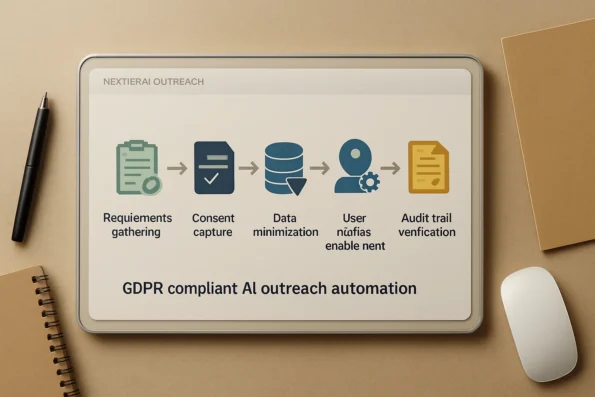
- Requirements Gathering and Preparation
Start by defining the scope of outreach automation and identifying all categories of personal data to be processed. Under the GDPR, any use of AI for outreach that involves personal data of EU data subjects must follow specific legal bases and controller responsibilities. Assess whether your planned activities require a Data Protection Impact Assessment according to the criteria set by the European Commission. Document the roles of all internal teams and third-party providers involved in the data flow. - Consent Mechanism Configuration
Configure explicit consent capture before initiating any outreach. In NextlerAI Outreach, establish workflows that trigger outreach only after clear, affirmative consent is logged from each data subject. This phase includes setting up consent records with time stamps and scope, ensuring compliance with GDPR Article 6 and detailed guidance from the European Data Protection Board. Integrate consent withdrawal handling to immediately halt processing upon request. - Data Flow Mapping and Minimization
Map each step where data moves or is processed within NextlerAI Outreach. Document sources, processing nodes, and storage locations. Apply strict data minimization: configure the platform to process only fields essential for outreach (e.g., name and email), excluding extraneous attributes. Limit access to personal data based on role assignments, in line with the principle of least privilege. - Control Setup and User Rights Enablement
Enable and document GDPR rights for data subjects—access, rectification, erasure, and objection—using NextlerAI Outreach’s control panels. Set up automated mechanisms that allow users to submit requests, and ensure there are procedures for prompt response and fulfillment. Configure retention settings so that personal data is automatically deleted or anonymized when no longer required for outreach purposes, supporting Article 5 principles. - Audit Trail and Compliance Verification
Activate audit logging in NextlerAI Outreach to record processing activities, consent changes, user rights actions, and access events. Regularly review audit trails against your documented risk register, confirming that all compliance controls remain effective and up to date. Conduct periodic audits to ensure end-to-end traceability and to demonstrate compliance to supervisory authorities, referencing the operational guidance from official GDPR resources.
Compliance checklist: Verifying outreach automation readiness
Establishing GDPR compliance for AI outreach automation requires more than initial configuration. You must operationalize key privacy, security, and documentation controls before launch and maintain vigilant oversight as workflows evolve. Use this checklist to systematically verify that your NextlerAI Outreach deployment—and your internal processes—meet the legal and operational requirements for handling EU personal data. Detailed product capabilities and deployment options are outlined on the NextlerAI Outreach product page. Teams seeking to embed data minimization into GDPR AI outreach automation should also review compliance, privacy, and regulatory obligations in AI-driven research pipelines. Obligations – European Commission documents the relevant background and implementation boundaries. SME Home | Data protection guide for small documents the relevant background and implementation boundaries.
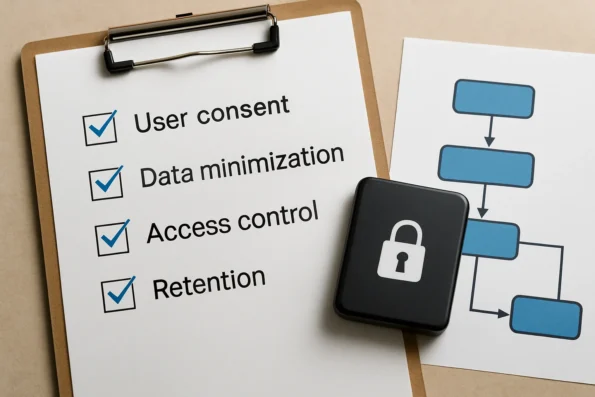
GDPR AI outreach automation: Operational readiness checklist
- Explicit user consent: Has explicit, verifiable consent been collected from every data subject prior to any outreach activity? Are records of consent securely stored and directly linked to each lead?
- Processing records: Is every automated processing activity—including prospect discovery, qualification, and message delivery—documented in an up-to-date record accessible for audit purposes?
- Data minimization: Are only those data fields strictly necessary for outreach included in the workflow? Has the logic for field exclusion or redaction been validated?
- Purpose limitation: Is the use of personal data clearly limited to the stated, consented outreach purpose, with no automatic repurposing or cross-use?
- Security controls: Are technical and organizational measures—such as encrypted storage, secure transmission, and logging—active throughout your NextlerAI Outreach setup?
- Role-based access: Are permissions for data access and configuration restricted by job function, with least-privilege enforced across all user accounts?
- Deactivation and offboarding: Is there a defined process for promptly deactivating user or administrator accounts when roles change or access is no longer required? (For specific steps, configure access and deactivation following product documentation.)
- User rights fulfillment: Can your processes reliably honor data subject rights, including access, rectification, erasure (right to be forgotten), restriction of processing, and objection to profiling?
- Retention limits: Are data retention policies enforced, with automatic deletion or anonymization of outreach data beyond the defined period?
- Documentation and audit readiness: Is documentation of all processing, consent, risk assessments, and technical controls maintained in a manner suitable for regulatory inspection?
- Handling data subject requests: Is there a documented, tested process for logging, tracking, and responding to data subject requests within the required timeframe?
- Ongoing review and improvement: Are periodic reviews scheduled to reassess risk, validate controls, and adjust documentation as workflows, regulations, or business requirements change?
- Automated control validation: Are automated controls, such as consent status checks and access logs, regularly tested for integrity and completeness to ensure no unauthorized processing occurs?
- Separation of duties: Have you ensured that the configuration, approval, and monitoring of outreach automation are assigned to distinct roles to reduce the risk of accidental or unauthorized changes to compliance-critical settings?
- Incident response readiness: Is there a documented and rehearsed procedure for identifying, documenting, and escalating suspected personal data breaches within the mandated 72-hour window, in line with GDPR Article 33?
- Vendor and sub-processor compliance: Have you verified that all third-party processors involved in your outreach automation provide evidence of GDPR adherence and can support your compliance obligations if data flows or hosting are outsourced?
For managing access and deactivation procedures in NextlerAI Outreach, consult the platform’s operational guide for license usage and domain/site management: NextlerAI operational guide. Completing this checklist positions your organization to meet GDPR obligations and demonstrate compliance if audited by EU authorities. The next section examines lessons learned from regulated sector deployments.
Key takeaways: Lessons from regulated sector workflows
Deploying GDPR AI outreach automation in regulated sectors reveals operational distinctions that set compliant workflows apart from standard digital marketing practices. The most effective deployments treat transparency, granular documentation, and repeatable controls as non-negotiable. Below, we distill actionable lessons from regulated industry implementation guides and practical experience with platforms such as NextlerAI Outreach. To reliably enforce user consent and auditability in your outreach pipeline, consult the workflow automation triggers guide for mapping automation to operational controls.
Documented consent and traceable processing are foundational
Regulated sector implementations consistently demonstrate that every stage of AI-driven outreach must be anchored by systematically logged, verifiable user consent. This goes beyond simple opt-in mechanisms: evidence of consent must be accessible, timestamped, and linked to specific data processing activities. Traceable processing enables organizations to reconstruct outreach decisions and interactions in detail—an expectation reinforced by regulatory guidance and sector audits. For example, NextlerAI Outreach can be configured to log and associate consent and processing activities at a per-user and per-campaign level, supporting robust evidentiary trails.
Clear access boundaries and operational segregation
Successful deployments in healthcare, finance, and legal environments highlight the need for precisely defined access boundaries. Access to outreach data and configuration must be restricted based on operational necessity and role, with technical enforcement at both platform and infrastructure levels. This reduces the risk of unauthorized processing and supports compliance with data minimization and purpose limitation obligations. Role-based access control, enforced within the automation platform and documented through access logs, is a common practice in regulated sector implementations, with periodic reviews to reassess access privileges.

Phased rollouts and rigorous risk documentation
Phased implementation is not simply a project management technique—it is a risk control mechanism in regulated industry settings. By introducing AI outreach automation in controlled phases, organizations can isolate, assess, and address risks before full-scale deployment. Each stage is accompanied by updates to the risk register, ensuring that evolving operational exposures are continuously documented and mitigated. This approach directly supports requirements for Data Protection Impact Assessments where applicable. In practical terms, phased rollouts may involve initial pilots in controlled environments, followed by iterative expansion as controls are validated and risk documentation is updated.
Heightened auditability and frequent policy reviews
Regulated sectors demand audit trails that are not only comprehensive but readily available for inspection. Auditability extends to both automated and manual interventions within the outreach pipeline. In practice, this means maintaining detailed logs of consent, data access, campaign configuration, and user rights requests. Policy reviews must occur more frequently than in unregulated environments, with clear records of policy changes, responsible owners, and implementation evidence. Audit logs should be immutable and retained for periods mandated by sectoral regulations, and audit processes must be rehearsed as part of routine compliance checks.
Sector-specific nuances: Mapping guides to platform configuration
Regulated industry guides emphasize that compliance is never achieved through generic templates. Instead, each legal and operational requirement—whether for consent, retention, or cross-border data transfer—must be mapped explicitly to controls within the chosen automation platform. For self-hosted solutions like NextlerAI Outreach, this includes adapting deployment architecture, documentation practices, and user rights interfaces to align with sector-specific rules and audit criteria. Implementation guides, such as the one at NextlerAI’s regulated industry compliance resource, recommend customizing workflows and access structures to meet jurisdictional and industry audit demands, and ensuring that every platform configuration is mapped to a documented regulatory requirement.
Definitions: Essential GDPR and automation terms explained
Understanding the precise meaning of GDPR and automation terminology is critical for anyone configuring or auditing AI outreach workflows. This section clarifies the most relevant terms, distinguishes legal requirements from recommended practices, and explains their operational significance for privacy-first outreach automation. Maintaining GDPR compliance in AI outreach requires robust editorial oversight and content governance, which are explored in depth in this workflow automation reference.
Personal data
Personal data refers to any information relating to an identified or identifiable natural person (the data subject). In outreach automation, this includes names, email addresses, professional roles, and any data traceable to an individual in the EU. Processing such data in AI-driven outreach—whether for initial contact, qualification or follow-up—triggers GDPR obligations.
Data subject
The data subject is the individual whose personal data is processed. In outreach contexts, each prospect or contact whose details enter the workflow is a data subject, regardless of their location if they are in the EU.
Explicit consent
Explicit consent is an unambiguous, informed, and freely given agreement by the data subject to process their personal data for a specific purpose. Under GDPR, explicit consent is a legal prerequisite before initiating outreach using personal data. For AI outreach automation, this means consent must be clearly captured, recorded, and verifiable before any marketing or engagement action commences.
Data minimization
Data minimization is the principle of collecting and processing only the personal data strictly necessary for a defined purpose. In AI outreach, this means limiting data fields to what is essential for prospecting or communication. Configuring minimization reduces exposure and supports compliance by demonstrating necessity and proportionality in data handling.
Profiling
Profiling is the automated processing of personal data to evaluate personal aspects—such as interests, behavior, or professional status. If your outreach automation segments contacts or adjusts messaging based on inferred characteristics, this activity may constitute profiling. GDPR imposes additional safeguards and, in some cases, transparency requirements for profiling.
Automated decision-making
Automated decision-making refers to decisions about individuals made solely by automated means, including AI algorithms, without human intervention. In outreach, fully automated qualification or lead scoring must be assessed for legal grounds, and data subjects may have the right to request human review of decisions that significantly affect them.
Processing activity
Processing activity encompasses any operation performed on personal data, whether automated or manual. This includes collection, storage, analysis, communication, and deletion. Each workflow step in AI outreach—from data ingestion to message delivery—constitutes a processing activity and must be documented for compliance purposes.
Audit trail
An audit trail is a chronological record of processing activities, consent captures, and access events. Maintaining robust audit trails is a GDPR requirement for automated outreach, supporting accountability and enabling verification in case of a regulatory audit or data subject request.
Lead capture
Lead capture denotes the process of collecting prospect data through forms, chatbots, or other automated channels. In GDPR-compliant AI outreach, lead capture mechanisms must include consent statements, minimize non-essential fields, and provide clear information on data use. For guidance on configuring lead capture within NextlerAI Outreach, refer to the official product documentation for terminology and technical setup related to consent and processing records.
Mandated requirements vs. best practices
It is essential to distinguish between GDPR-mandated requirements—such as explicit consent, data minimization, processing documentation, and user rights enablement—and best practices, which may include enhanced audit logging, additional transparency notices, or layered access controls. Legal obligations must always be met; best practices can further reduce risk and support ongoing compliance, but cannot substitute for explicit regulatory requirements.
FAQ
What are the main GDPR risks in automating AI-powered outreach?
The core risks include unauthorized or excessive processing of personal data, failure to obtain explicit user consent, profiling without safeguards, untracked data retention, and insufficient user rights management. Automated outreach amplifies these risks because large volumes of personal data are processed at speed, making errors or oversights more consequential. Each risk must be proactively managed with technical and operational controls tailored to the outreach context. Additionally, the use of AI models may introduce risks of algorithmic bias or inadvertent inference of sensitive attributes, emphasizing the need for transparency and safeguards in decision logic.
How can I map GDPR controls to each stage of an AI outreach workflow?
Mapping starts by breaking down the workflow into intake, processing, decision-making, and communication phases. For each, identify what personal data is used, why it is needed, and what lawful basis applies. Implement consent capture at data intake, apply minimization and purpose limitation during processing, log decisions and data flows, and enforce access controls at every phase. Document these mappings so each control can be traced to a GDPR requirement. Review the workflow regularly, updating controls as processes change, and involve data protection officers or relevant stakeholders to validate ongoing compliance during process modifications or system updates.
Which operational risks must be recorded when deploying automated outreach?
Operational risks include lack of consent verification, incomplete audit trails, uncontrolled data propagation across providers, delays in honoring erasure requests, and misaligned retention policies. Each risk should be described in a risk register with assessment of likelihood, impact, responsible owner, control measures, and review status. Recording these risks supports monitoring, auditability, and continual improvement in compliance posture. Furthermore, cross-provider data transfers and integration with external tools may increase exposure to unintentional data leakage or jurisdictional non-compliance, so these factors should be explicitly tracked.
What are the practical steps to implement GDPR-compliant AI outreach with NextlerAI Outreach?
Key steps include configuring consent capture and logging mechanisms, limiting data fields to what is strictly required, setting up retention and access controls, and enabling user rights management (such as erasure and export). Ensure all workflow automations are auditable, assign permissions based on roles, and align configuration with defined GDPR controls. Review the operational setup regularly to address evolving risks or requirements. It is also critical to validate that automated decision points can be explained and overridden if necessary, and to use NextlerAI Outreach’s audit trail and configuration logs to support compliance reviews and investigations.
How can I verify and document GDPR compliance in my AI outreach pipeline?
Verification relies on maintaining up-to-date records of processing activities, consent logs, risk registers, and audit trails. Conduct periodic internal audits, validate that all consent and data minimization mechanisms are active, and ensure evidence is collected for each control. Documentation should be clear, current, and accessible for regulatory review. Regularly update compliance materials in line with workflow or regulatory changes. Where possible, implement automated monitoring of control status and ensure that changes to processing activities are promptly reflected in compliance documentation and risk assessments.
What are the essential GDPR terms and how do they apply to AI outreach automation?
Important terms include personal data (any information relating to an identifiable person), data subject (the individual whose data is processed), explicit consent (clear permission for data use), data minimization (limiting data to what is necessary), and automated decision-making (decisions made without human intervention). In AI outreach, each term corresponds to a required safeguard or operational practice. Understanding these terms is crucial for configuring compliant, privacy-first automation pipelines. Audit trail and profiling are especially relevant: audit trails provide accountability, while profiling requires additional safeguards and the ability to respond to data subject objections.
Conclusion
Establishing GDPR-compliant AI outreach automation requires a methodical, evidence-based approach grounded in operational reality. By mapping regulatory obligations directly to technical controls, organizations can ensure their AI-driven outreach respects data subject rights and withstands legal scrutiny. NextlerAI Outreach supports this rigor through self-hosted deployment, configurable privacy workflows, and explicit consent mechanisms—enabling teams to align every automation step with documented compliance objectives.
Successful implementation depends not only on initial technical configuration but also on the ongoing orchestration of multiple compliance mechanisms. This includes maintaining granular audit trails that record all consent events and processing activities, ensuring that every outreach workflow is tied to a clearly defined legal basis, and systematically restricting data access based on user roles. Decisions regarding data retention, profiling, and permissible processing activities must be periodically revisited to account for operational changes and regulatory updates. The controller organization is responsible for assigning and documenting these controls, while processors and technology providers, such as NextlerAI Outreach, facilitate compliance through their platform features and deployment models. A collaborative governance structure—spanning legal, technical, and operational teams—underpins continuous compliance and enables rapid adaptation to evolving risks and requirements.
As your next action, appoint a multi-disciplinary lead to oversee a comprehensive review of your outreach automation configuration. This ensures that consent capture, data minimization, access controls and risk documentation are actively maintained and auditable. Regularly verify that workflow changes preserve privacy-first design and update your risk register and checklist in line with evolving regulatory guidance and operational findings. This proactive governance approach positions your organization for lasting GDPR compliance as automation scales.