







Introduction
AI media management automation enables content leaders to transform how digital assets are sourced, described, organized, and governed throughout the publishing workflow. By leveraging artificial intelligence, teams can automate repetitive tasks such as intelligent image sourcing, section-aware placement, alt text suggestion, library naming, and compliance checking. The result is a streamlined workflow that reduces manual effort, accelerates publishing, and improves consistency—while ensuring human oversight remains where it matters most.
This article is designed for content managers, editors, digital publishers, marketing teams, and technical leads seeking practical guidance on deploying AI-driven media management. You will learn how to select and configure automation for image, metadata, and compliance processes, understand current platform capabilities and regulatory boundaries, and implement robust risk controls. By focusing on workflow-centric, risk-aware practices, this resource helps you optimize media operations without sacrificing editorial quality or compliance accountability.
AI media management automation draws on a range of underlying mechanisms, including computer vision for image selection, natural language processing for alt text, and rule-based logic for compliance checks. Automation can be fully autonomous for structured actions, such as format conversion or duplicate detection, while human review is retained for context-sensitive or regulated tasks. Leading platforms—such as those supporting section-aware image placement and automated metadata suggestion—allow organizations to set granular automation policies matching their workflow and editorial standards. Regulatory requirements, such as those referenced in the EU AI Act (2024) for high-risk systems and IEEE 7007-2021 for media management terminology, mean teams must balance automation benefits with documented oversight and process controls. By clarifying these foundational concepts upfront, readers will be equipped to make informed, accountable decisions about where and how to safely introduce automation into digital media management.
Clarifying AI-Driven Media Management Tasks and Terms
Defining AI Media Management Automation
AI media management automation refers to technology systems designed to use artificial intelligence for assisting or automating tasks across image sourcing, alt text generation, media library organization, and compliance checks within digital publishing workflows. These mechanisms operate by analyzing content structure, applying computer vision or natural language processing, and using predefined rules or models to streamline routine media tasks.
Scope and Boundaries of Automation
The practical scope of AI automation in media management varies across task types. Fully automatable actions include repetitive operations such as image format conversion (e.g., bulk conversion to WebP), along with initial image categorization and section-based library placement. However, tasks like final alt text review for accessibility and sign-off on compliance warnings require careful human intervention, as AI-generated outputs may not fully capture context or meet regulatory and editorial standards.
Section-Aware Image Sourcing and Placement
Platforms such as NextlerAI Publisher enable structured, section-aware image sourcing and placement within WordPress publishing pipelines. This approach uses AI to match relevant images to specific content sections, drawing from pre-approved libraries or compliant sources, and positioning them according to editorial guidelines. These automations can reduce manual effort and support consistent visual alignment in large-scale publishing operations.

Automated Alt Text Generation
Automated alt text solutions use AI to generate descriptive text for images based on visual analysis and contextual cues. While this accelerates the initial metadata creation process, current best practice—and regulatory expectation—requires editorial review to ensure precise accessibility, especially for users relying on screen readers. Automated outputs may misinterpret nuanced content or fail to convey essential context, making human oversight mandatory.
AI-Driven Media Library Organization
Media library management with AI encompasses features such as section-based categorization, consistent naming conventions, and automated format handling. Systems like NextlerAI Publisher allow for optimized storage and retrieval, easing the burden of manual sorting and ensuring assets remain organized as library size grows. These automations do not eliminate the need for editorial curation, but they improve baseline order and reduce operational bottlenecks.
Automated Compliance Checks in Publishing Workflows
Modern AI media management platforms can surface quality or compliance warnings before publication, flagging potential issues such as missing alt text, improper formats, or policy violations. These automated checks are designed as pre-publication safeguards and should be treated as risk indicators—not as substitutes for regulatory compliance. Human review is essential for confirming that content meets jurisdiction-specific legal requirements and organizational standards.
Consistent Terminology and Standards
For clarity and interoperability, established terminology and data format guidelines—such as those defined in IEEE 7007-2021—should be used when describing AI-powered media management systems. Adhering to these standards improves system integration, auditing, and reporting across platforms, and facilitates reliable communication among stakeholders in compliance-sensitive environments.
Making the Right Automation Decisions for Your Team’s Workflow
Choosing which media management tasks to automate requires a practical, stepwise approach that balances workflow efficiency, editorial control, and regulatory compliance. The following process helps content leaders ensure that automation supports, rather than undermines, quality and accountability. To understand the editorial workflow automation boundaries that impact image selection, approvals, and scheduling, see how real publishing pipelines define and enforce these stages.
- Map Core Media Tasks to Workflow Stages: Begin by listing all media-related tasks in your publishing workflow—such as image sourcing, alt text creation, library organization, and compliance checks. Clarify at which stage each task occurs and who is responsible for review or approval. Consider the distinct mechanisms and handoffs between automation and manual review at each stage.
- Assess Automation Value for Each Task: Evaluate where automation delivers the greatest operational benefit. For example, AI-driven image sourcing can accelerate section-aware placement, while automated format conversion (e.g., to WebP) ensures consistency at scale. Identify bottlenecks and repetitive actions that can be safely delegated to technology. Examine current delays or errors that automation could reduce, and weigh these gains against any additional oversight that may be required.
- Determine Required Editorial Oversight: For every task, decide how much human input is essential. Automated alt text generation, while efficient, should always trigger editorial review to meet accessibility standards. Similarly, compliance warnings identified by AI need human evaluation before publication to minimize legal and reputational risks. Define criteria for when human approval is mandatory—such as for any AI-generated content that impacts accessibility or regulatory disclosures.
- Review Regulatory and Policy Requirements: Reference applicable regulations, such as the EU AI Act (digital-strategy.ec.europa.eu) and NIST AI Risk Management Framework (nist.gov), to define obligations specific to your organization’s role as a controller, processor, or deployer. For compliance automation, ensure that any AI system’s outputs can be audited and that human sign-off is always available for high-risk content. In the EU, for example, deploying high-risk AI systems in media workflows requires documentation of transparency, human oversight, and traceability. Confirm that your chosen AI tools support evidence logging and audit trails suitable for regulatory review.
- Set Explicit Automation Boundaries: Establish documented rules for which tasks are fully automated, which require human-in-the-loop approval, and which remain manual. This reduces the risk of over-automation and helps clarify accountability. For example, a team might automate image sourcing and library updates, but retain manual review for alt text and compliance sign-offs. Define fallback mechanisms for when automation fails or when a human override is necessary, and ensure these boundaries are reviewed regularly as platform capabilities evolve.
- Select Supporting Platforms with Proven Controls: Choose automation platforms that provide configurable workflow checkpoints, access logs, and compliance evidence. Solutions like NextlerAI Publisher are designed to support structured automation for image sourcing, alt text suggestions, and compliance reports within WordPress, with clear boundaries for human review. Confirm that the platform’s configuration allows for mandatory editorial gates and accessible audit trails, as detailed in the NextlerAI Publisher quality rules guide.
- Document and Communicate the Automation Policy: Ensure all team members understand which processes are automated, where oversight is mandatory, and how to escalate exceptions or quality concerns. This documentation is critical for maintaining transparency and for regulatory audits. Update internal guides as automation boundaries or regulatory requirements change, and provide clear contacts for questions about workflow exceptions.
By following these decision steps, publishing teams can confidently implement AI media management automation, delivering efficiency without compromising editorial or compliance standards. The next section presents a structured comparison of automation approaches for each core media task.
Implementation Decision Table: Comparing AI Media Management Approaches
Understanding which media management automation approach fits your publishing workflow requires a clear, side-by-side view of mechanisms, editorial checkpoints, integration, and regulatory considerations. The table below contrasts core tasks—image sourcing, alt text, library organization, and compliance checks—across automated, human-in-the-loop, and manual methods. It specifies where platforms such as NextlerAI Publisher deliver workflow automation in WordPress, notes the editor’s role in oversight, and highlights compliance and risk boundaries based on current standards and official documentation. For teams aiming to align media with content topics, reviewing AI topic discovery pipelines can help clarify how automated research guides effective image sourcing and placement. IEEE SA – IEEE 7007-2021 documents the relevant background and implementation boundaries.
| Task | Automation Mechanism | Editorial Control | Platform Example / Integration | Compliance & Risk Considerations | Source |
|---|---|---|---|---|---|
| Image Sourcing & Placement | Automated (section-aware sourcing, subject detection) | Editor reviews selections and placement before publication | NextlerAI Publisher structured workflow for WordPress | Requires human confirmation to avoid license and context errors; audit trail recommended | NextlerAI Publisher product page, Publisher Images Guide |
| Alt Text Generation | Automated suggestion; human-in-the-loop for accuracy | Mandatory editor validation for accessibility and context | NextlerAI Publisher (suggests alt text, supports review in workflow) | WCAG and regulatory standards require human sign-off; automated output cannot guarantee accessibility | Publisher Images Guide, EU AI Act |
| Media Library Organization | Automated (section-based placement, naming, format conversion) | Editor can override organization and ensure taxonomy alignment | NextlerAI Publisher media management for WordPress | Format conversion (e.g., WebP) must comply with platform and browser standards; consistent naming aids auditability | Publisher Images Guide, IEEE 7007-2021 |
| Compliance & Quality Checks | Automated warnings and blockers; human-in-the-loop for resolution | Editor must review flagged issues and log sign-off before publishing | NextlerAI Publisher compliance reporting workflow | EU AI Act and NIST AI RMF require documented, accountable review of AI outputs in regulated publishing | Publisher Quality Rules Guide, EU AI Act, NIST AI RMF |
| Manual Approach (All Tasks) | Manual (no automation) | Full editorial responsibility at every step | Native WordPress media library, manual uploads and checks | Lower automation risk but higher labor; suitable for high-sensitivity workflows or when regulatory obligations are unclear | WordPress official documentation |
This table illustrates not just functional differences but also the mechanisms by which AI-driven systems integrate into existing editorial processes. Automated image sourcing leverages algorithms for section-aware relevance and subject detection, but platforms like NextlerAI Publisher route all proposed selections through human review prior to publication. This review step is essential for mitigating risks such as improper licensing, context mismatch, or visual inappropriateness. For alt text, automated suggestions are generated using natural language models, but explicit editor validation is required before content is published—a constraint driven by accessibility regulations such as WCAG and referenced in the EU AI Act. In library organization, automation manages section-based placement, standardized naming, and on-the-fly format conversion (such as to WebP), while allowing editors to override automated taxonomies to ensure alignment with internal conventions or campaign-specific requirements.
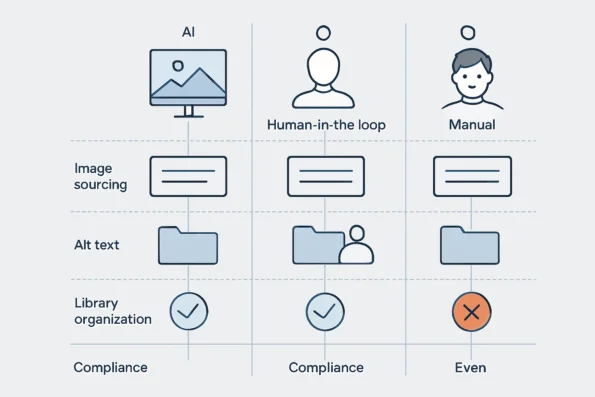
Compliance and quality check automation operates by flagging or blocking issues that breach customizable rules (such as missing alt text or unsupported formats). However, the requirement for the editor to log a final sign-off ensures that regulatory frameworks like the EU AI Act and NIST AI RMF are met, maintaining a clear record of human accountability. Each of these workflow automations is supported by documentation and audit trails, which are crucial for regulated environments or for post-publication quality assurance. Manual approaches, while reducing automation risk, significantly increase editorial workload and are generally reserved for highly sensitive or unregulated contexts.
Ultimately, the decision table clarifies how automation can be configured to balance efficiency with oversight, and underscores the need for clearly documented editorial checkpoints—especially where regulatory compliance and accessibility are non-negotiable. The next section distills the practical operational and governance shifts that occur when these automation frameworks are adopted.
Key Takeaways: What Changes with AI Media Management Automation
Adopting AI media management automation brings measurable shifts in how publishing teams handle images, metadata, and compliance tasks. The automation of image sourcing, placement, and formatting can substantially reduce manual workload, but the process must incorporate well-defined review points. Editorial validation of metadata and compliance evidence is essential to ensure both content quality and adherence to legal and accessibility standards. A well-structured media library also supports the automated content brief workflow, which ensures that images, metadata, and section assignments remain consistent across projects. MediaConvert documents the relevant background and implementation boundaries.
Automated generation of metadata and alt text allows organizations to accelerate large-scale publishing, especially when managing extensive media libraries. However, for accessibility—particularly for visually impaired users—human review of AI-generated alt text remains a non-negotiable checkpoint. This safeguard prevents errors and ensures alignment with best practices for inclusive digital experiences.
AI-driven organization of media libraries, including intelligent file naming and section-aware placement, supports scalable publishing environments. These mechanisms enable faster discovery, retrieval, and repurposing of assets, reducing redundancy and improving operational efficiency as content volumes grow. Platforms that implement these controls, such as NextlerAI Publisher, help teams maintain consistent standards across dynamic workflows.

Automated compliance checks can flag potential issues early in the workflow, alerting editors to blockers and quality warnings before publication. Yet, regulatory frameworks such as the EU AI Act make it clear: automation may assist, but human accountability for compliance cannot be delegated. Editorial teams must retain final sign-off, particularly for regulated domains or when handling sensitive data.
To fully realize the benefits of automation, editorial workflows must be updated to integrate new review gates and quality controls. This includes retraining staff, revising standard operating procedures, and maintaining clear documentation of where automation begins and ends. Doing so not only streamlines content production, but also ensures that governance and accountability keep pace with technological change.
Key Takeaways
- Operational efficiency increases: Automation streamlines media management by reducing repetitive manual actions, such as sourcing and formatting images. This lets content teams focus on higher-value editorial and creative work while maintaining faster production cycles.
- Editorial oversight remains essential: While AI can handle routine metadata and compliance flagging, designated editorial checkpoints are needed for alt text accuracy, sensitive content, and regulatory compliance. These checkpoints must be strategically placed to intercept errors that automation might miss.
- Governance and documentation evolve: Automating media management obliges teams to record exactly where automation is applied, who is responsible for final approval, and how exceptions are handled. This bolsters transparency, which is increasingly required under frameworks such as the EU AI Act (digital-strategy.ec.europa.eu).
- Media library scalability improves: AI-driven systems support growing content operations by organizing assets with contextual metadata, section-aware placement, and standardized naming conventions. This reduces asset duplication and makes compliance audits more manageable.
- New training and workflows emerge: Teams must update onboarding and ongoing training to address automated processes, focusing on how to intervene when AI outputs require correction. Editorial policies should expressly define which tasks are always subject to human review.
- Regulatory readiness becomes routine: Automated compliance checks can surface potential risks and help teams maintain best practices, but legal responsibility for published content remains with human editors and content owners. Processes must be auditable and align with regulatory expectations (nextlerai.com).
As automation transforms media workflows, these changes demand ongoing attention to the balance between technological efficiency and the human judgment required for quality, ethics, and compliance. The next section equips teams with a practical checklist for safe and effective automation launch.
Checklist: Ensuring a Safe and Effective AI Media Workflow
To safeguard quality and compliance in AI media management automation, every digital publishing team should anchor implementation in a clear, documented checklist. The following operational points are derived from regulatory frameworks, platform documentation, and proven industry practice. Each item addresses a key control or decision point that supports both workflow efficiency and risk management. When implementing automated alt text or metadata, refer to automated SEO in publishing pipelines to see how AI-driven processes intersect with accessibility and quality safeguards.
- Define specific automation goals for each media management task—such as image sourcing, alt text creation, library organization, and compliance checks—so every automated action aligns with editorial and business objectives. Specify measurable targets (e.g., reduce manual image sourcing by 70%) and clarify which aspects require full automation versus partial or human-in-the-loop processing. Document these goals to ensure alignment among editorial, IT, and compliance stakeholders.
- Configure all relevant platform settings for image handling, alt text suggestion, and media library organization. Ensure that automated operations, such as section-aware image placement or format conversion, are mapped to your content structure. Assign responsibility for configuring settings at both global (platform-wide) and project-specific levels, and maintain a change log for all configuration adjustments. Use platform features to define acceptable sources, permissible formats, and naming conventions for automated actions.
- Set up compliance warnings and quality control rules within your platform, specifying conditions that trigger alerts or block publication. These should be based on documented requirements in regulatory frameworks like the EU AI Act and NIST AI Risk Management Framework. Implement logic to flag missing alt text, unresolved copyright status, or metadata inconsistencies. If your platform allows, create tiered alerts (informational, warning, blocking) to match the severity of detected issues.
- Conduct a rigorous pre-launch test using representative content samples to verify that automated sourcing, metadata, and compliance logic function as intended. This test should uncover edge cases and potential workflow bottlenecks before full rollout. Employ structured testing protocols (see NextlerAI’s pre-launch test plan) and involve both editorial and technical reviewers to validate output accuracy, error handling, and audit trail completeness. Document all test outcomes and required remediations.
- Establish editorial review gates for automated metadata—including alt text—and for any compliance outputs. Define required human sign-off points to maintain accountability for accessibility and regulatory adherence. Determine which roles are authorized to approve or reject automated outputs, and implement workflow controls (e.g., publication holds) to enforce these checkpoints. Track reviewer comments and decisions for auditability.
- Document fallback procedures and escalation contacts so that if automation fails or a compliance risk is detected, your team knows the immediate next steps and responsible parties. This supports operational continuity and regulatory readiness. Specify manual reversion procedures, criteria for reverting to previous media versions, and contact details for technical support and compliance officers. Ensure all team members have access to this documentation and that escalation paths are periodically reviewed and updated.
This checklist, when tailored to your publishing environment and platform capabilities, forms a foundation for a controlled, auditable AI media workflow. For detailed pre-launch protocols and evidence requirements, consult authoritative platform and regulatory resources as appropriate, such as the NextlerAI Publisher pre-launch test plan.
Expert Caution: Risk Controls and Oversight in AI Media Automation
AI media management automation can streamline repetitive tasks, but it introduces complex compliance and accountability requirements. Teams must recognize that automation does not absolve publishers of legal or editorial responsibility for accessibility and regulatory compliance. For example, even when platforms generate automated alt text or surface compliance warnings, editorial sign-off is non-negotiable to meet jurisdictional standards and audience needs. This is especially critical for organizations operating across multiple jurisdictions, where regulatory expectations may differ or evolve, making ongoing vigilance essential. For more on evaluating oversight controls, see this AI workflow automation tool comparison. Applying robust risk controls in AI media management is especially important for international teams; see the practical safeguards detailed in AI multilingual content automation for regulated or multilingual publishing environments.
Accountability: Human Oversight Remains Mandatory
Regulatory frameworks—including the EU AI Act and the NIST AI Risk Management Framework—make clear that organizations deploying AI in publishing workflows are responsible for risk assessment, ongoing monitoring, and final content approval. These frameworks distinguish between AI system providers, deployers, and controllers, but consistently place the burden of risk management and documentation on the entity publishing or processing content. In all cases, human review of AI-generated alt text and compliance warnings is essential to avoid accessibility violations and reputational risk.
Editorial responsibility cannot be delegated to automation. For example, the EU AI Act requires that deployers of AI systems continuously monitor for risks and maintain comprehensive documentation of decision-making processes (see EU AI Act). Teams should implement auditable processes ensuring that alt text, image placements, and compliance markers are verified by qualified staff before publication. Consistent internal training and documented review protocols further mitigate risk of accidental noncompliance or inappropriate content deployment.
Staying Current With Platform Boundaries and Change Logs
Automated media management tools—such as those supporting image sourcing, section-aware placement, or metadata generation—evolve continuously. Editorial and technical leads should routinely review platform documentation and official change logs to identify modifications in automation boundaries or newly introduced compliance features. Failure to track updates can result in unintentional scope creep, where tasks previously requiring human oversight become silently automated, undermining established governance.
Responsible teams should assign clear ownership for monitoring product updates and maintaining an up-to-date register of automation boundaries. Any detected changes—such as expanded AI-generated metadata or new compliance modules—should prompt a documented review of editorial procedures. This ensures that any shift in the automation workflow does not bypass mandated human checks or introduce new unvetted risks.

Comparative Evaluation: Select Platforms With Proven Controls
Not all AI media management platforms are equal in their approach to controls and transparency. Practical selection should focus on solutions that offer robust workflow visibility, configurable review checkpoints, and clear mechanisms for surfacing compliance issues before publication. For example, platforms like NextlerAI Publisher implement structured workflows and audit trails within WordPress, supporting teams to document actions and satisfy the evidence requirements of modern regulatory frameworks.
During vendor evaluation, prioritize platforms with detailed permission controls, audit logging, and explicit documentation of automation boundaries. Where platform documentation is lacking or ambiguous, escalate for clarification before deployment. This comparative diligence reduces the likelihood of regulatory breaches and strengthens editorial accountability.
Referencing Official Standards and Data Guidance
IEEE 7007-2021 provides standardized terminology and data format expectations for AI-powered media management systems, supporting consistency and interoperability. Adherence to such standards strengthens governance and facilitates integration with audit or risk management processes mandated by regional or sector-specific regulations.
FAQ
How does AI automate image selection and placement in publishing workflows?
AI-driven publishing platforms use computer vision and natural language processing to identify relevant images based on article structure and section context. These systems break down the article into its logical sections, extract key themes and entities, and match them with appropriate images from approved libraries or external sources. Section-aware automation, as implemented in specialized tools, aligns each image with its corresponding content area by evaluating metadata, editorial priorities, and platform rules. Image placement can also be guided by structured templates, ensuring consistency and reducing manual input. All selection and placement actions are logged for editorial auditing, maintaining transparency and compliance throughout the publishing pipeline.
What are the current limitations of automated alt text generation?
Automated alt text tools can generate descriptive tags for images using AI, but these outputs often lack full context or may miss nuances critical for accessibility compliance. Such systems may incorrectly label objects, omit important relationships, or provide overly generic descriptions that do not serve users who rely on screen readers. Contextual understanding is limited to what the algorithm can infer from the image and surrounding text, which may not capture the editorial intent or the unique communicative function of each image. As a result, regulatory and quality frameworks require human review of all generated alt text to ensure accuracy, adequacy, and alignment with accessibility standards before publication.
How can AI help organize and maintain large media libraries?
AI assists in organizing media libraries by automatically categorizing, naming, and converting images according to section-based logic and file format requirements (such as converting to WebP). The system can enforce consistent metadata, flag duplicates, and maintain structured placement within the library, particularly for high-volume publishing environments. AI-powered tagging leverages both image analysis and content associations to improve searchability and archival processes. Integration with publishing platforms enables real-time updates, while automated file versioning and deduplication mechanisms help preserve library integrity. These features collectively reduce manual sorting and help maintain an organized, scalable library as content volume increases.
What compliance risks and controls are relevant for AI media automation?
Regulatory frameworks such as the EU AI Act and NIST AI Risk Management Framework identify the need for human oversight, transparent audit trails, and documented boundaries when deploying AI in media workflows. Risks include incomplete accessibility support, misclassification of sensitive images, and inadequate documentation for regulatory inquiries. Compliance controls involve regular quality checks, mandatory human sign-off for compliance-critical outputs, and adherence to recognized data and terminology standards such as IEEE 7007-2021. Teams must also ensure traceability of automated decisions and maintain up-to-date records of both automation logic and human interventions, so that compliance with legal and industry-specific requirements can be demonstrated during audits or investigations.
What practical steps ensure a safe and effective AI-managed media workflow?
To maintain operational safety and compliance, teams should establish clear automation boundaries, configure platform-level permissions, and implement multi-stage editorial review of automated outputs. Workflow documentation should describe each automation’s scope, review trigger, and escalation protocol. It is essential to routinely verify platform updates and automation logic against regulatory obligations to avoid unintentional drift in compliance standards. Maintaining a detailed change log, along with role-based access and regular training, helps safeguard the workflow from unauthorized changes and ensures continuity in oversight. For exceptional scenarios flagged by the AI, escalation procedures should route issues promptly to designated editorial or compliance leads. These safeguards collectively support a robust, reliable, and auditable AI-driven media management process.
Conclusion
Adopting AI media management automation is a strategic decision that fundamentally changes how digital publishing teams handle images, metadata, and compliance. The real benefit lies in combining automation for speed and scale with structured editorial oversight to guarantee accessibility and regulatory alignment. Effective deployment requires a clear understanding of each task’s automation boundaries and an unwavering commitment to human review where legal, ethical, or quality standards demand it.
When determining your automation approach, prioritize transparency at every stage. Select platforms that provide not only configurable controls but also clear process visibility—such as granular audit trails, permission management, and workflow logging—to support ongoing accountability. Implementation decisions should be informed by a careful mapping of your publishing workflow, documenting which tasks are automated, which are subject to human-in-the-loop review, and where final editorial sign-off is required. Integrating these mechanisms enables your team to respond to regulatory obligations, such as those mandated by the EU AI Act for deployers and controllers, or guidelines from the NIST AI Risk Management Framework for ongoing monitoring and risk assessment. Rigorous documentation is essential: record each automation boundary, review checkpoint, and compliance policy update to ensure readiness for internal governance audits or external regulatory scrutiny. Regularly engage stakeholders—including editorial, legal, and IT teams—to review the impact of automation, address any gaps in oversight, and update processes as standards evolve.
To move forward, schedule a cross-functional review of your current media workflow and identify areas where automation can be safely introduced or optimized, ensuring each proposed change is backed by documented controls and supported by regulatory guidance.