







Introduction
Implementing AI in regulated industries demands more than technical capability—it requires a precise alignment of product controls with industry-specific legal and operational mandates. NextlerAI regulated industry implementation addresses this challenge by offering configurable mechanisms mapped to the compliance needs of sectors such as healthcare, finance, and legal services. Whether you are an IT leader, compliance officer, or digital transformation manager, your objective is to leverage automation for efficiency while maintaining strict oversight, privacy, and auditability demanded by frameworks like the NIST AI Risk Management Framework, the EU Artificial Intelligence Act, and, in healthcare, FDA guidelines.
This guide delivers actionable, sector-specific directions for deploying NextlerAI Assistant and NextlerAI Publisher in WordPress-based environments. It explains how manual API key configuration, domain-restricted licensing, role-based permission management, and knowledge base curation directly support legal requirements for transparency, access control, and traceability. You will learn how to adapt these controls to respect data privacy, ensure human-in-the-loop oversight, and establish a defensible audit trail—fundamental expectations in regulated operations.
NextlerAI’s approach to regulated environment deployment centers on giving organizations granular control over automation boundaries. Each product allows administrators to explicitly define user roles and action entitlements, ensuring that only authorized personnel can access sensitive tasks or information. Knowledge base content is tightly scoped by administrators, with clear separation between internal and public-facing materials, supporting both operational effectiveness and compliance with sectoral data minimization principles. Auditability is maintained through robust logging features, making it possible to reconstruct decision trails and interventions for internal review or external audit. This modular, policy-driven configuration enables you to tailor deployments to your organization’s risk profile and regulatory exposure, rather than relying on generic automation presets.
By following the structured approach detailed in this resource, you can confidently configure NextlerAI products to meet both organizational policy and external regulatory obligations. This readiness is essential for responsible AI adoption, and for demonstrating compliance in audits or regulatory reviews. The remainder of this guide provides a clear table of contents, enabling you to access tailored implementation guidance, sector-specific comparisons, practical configuration steps, and illustrative deployment scenarios for regulated settings.
- Defining Regulated AI Implementation and Sector-Specific Requirements
- Cross-Industry Implementation Table: Mapping NextlerAI Controls to Compliance Needs
- Visual Summary: Compliance-Centric Workflows in Healthcare, Finance, and Legal Sectors
- Actionable How-To Steps for Regulated Industry Deployment
- Illustrative Scenario: Deploying NextlerAI Assistant in a Regulated Healthcare Setting
- FAQ
- Conclusion
Defining Regulated AI Implementation and Sector-Specific Requirements
What Is Regulated Industry Implementation for AI in WordPress Automation?
Regulated industry implementation of AI refers to the deployment, configuration, and governance of AI tools in environments governed by strict legal and operational requirements. In WordPress-based settings, this means every process—from data handling to content generation—must align with sector-specific laws and formal risk management frameworks. Implementation is not solely technical; it encompasses policy, human oversight, and traceability to provide demonstrable compliance at every stage. For a deeper understanding of data privacy and compliance in NextlerAI deployments, review the data privacy and compliance guide. For sustained compliance and support accuracy, consult the knowledge base optimization process for NextlerAI Assistant to maintain curated, permissioned informational boundaries. NextEra Energy Strategy and Business Model documents the relevant background and implementation boundaries.
Core Regulatory Frameworks by Sector
Each regulated sector is subject to distinct legal duties:
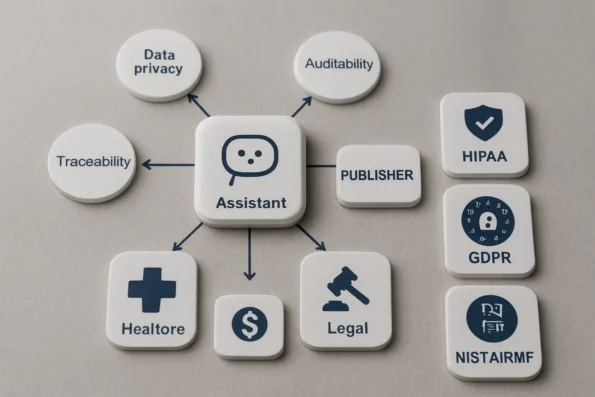
- Healthcare (U.S.): Systems must comply with HIPAA for patient data privacy. The FDA’s guidelines for AI in software as a medical device require strict traceability, risk management, and the capacity for audit and human review.
- Finance and Legal (EU): GDPR governs personal data processing for finance and legal services, mandating lawful basis, transparency, and data minimization. The EU Artificial Intelligence Act introduces obligations for transparency, human oversight, and risk categorization, especially for high-risk AI applications.
- All Sectors: The NIST AI Risk Management Framework offers a universal standard for trustworthy, transparent, and accountable AI across industries, emphasizing documentation, access management, and robust audit trails.
Key Compliance Obligations: Data Privacy, Auditability, Oversight, and Traceability
Regulated AI deployments must satisfy several overlapping obligations:
- Data Privacy: Only the minimum necessary data should be processed, with clear boundaries set for training and inference content.
- Auditability: Systems must generate records of actions, content changes, and user interventions to enable post-hoc review.
- Human Oversight: Critical actions—such as publishing content or responding to sensitive queries—require defined stages of human approval and review.
- Traceability: Organizations must document model inputs, user actions, and content versions to reconstruct decision-making chains if necessary.
Distinguishing Legal Requirements from Best Practices
Legal requirements represent non-negotiable obligations established by statutes or regulators, such as HIPAA-mandated access controls in U.S. healthcare or GDPR’s explicit consent for data processing in the EU. Best practices, while not legally binding, include measures like regular policy reviews, role-based permission refinement, and proactive monitoring—elements recommended by risk management frameworks like NIST AI RMF. Effective implementation requires clear separation between what is mandated and what is advisable, ensuring baseline compliance while supporting continuous improvement.
NextlerAI Product Roles and Compliance-Relevant Capabilities
NextlerAI provides two principal WordPress-native tools for regulated environments:
- NextlerAI Assistant: A multilingual AI sales and support agent for WordPress and WooCommerce. Compliance-relevant features include knowledge base curation, granular permissions, domain-bound API credentials, and configurable boundaries for both input and output. Human oversight is supported through configurable approval workflows for high-risk actions.
- NextlerAI Publisher: Automates structured content creation and editorial review within WordPress. It supports workflow approvals, staged content review, and scheduling, allowing organizations to control when and how AI-generated content is published. Audit trails and review histories ensure traceability and accountability, essential for regulated sectors.
Neither product is prescriptive; both require deliberate configuration by administrators. Manual assignment of API keys, explicit environment designation, and controlled deployment to production are mandatory. Compliance is achieved only when organizations align these product controls with their sector’s legal and operational requirements.
Cross-Industry Implementation Table: Mapping NextlerAI Controls to Compliance Needs
Deploying AI in regulated sectors requires deliberate mapping of technical controls to legal and operational requirements. The following table details how NextlerAI Assistant and Publisher configuration options address compliance criteria in healthcare, finance, and legal environments. It provides a clear, evidence-backed view of which sector-specific obligations are met by each mechanism, drawing directly from official documentation and regulatory frameworks. NIST AI Risk Management Framework (AI RMF 1.0) documents the relevant background and implementation boundaries.
| Control Category | Healthcare (e.g., HIPAA, FDA, NIST AI RMF) | Finance (e.g., GDPR, EU AI Act, NIST AI RMF) | Legal (e.g., GDPR, EU AI Act, NIST AI RMF) | NextlerAI Configuration Mechanism | Source |
|---|---|---|---|---|---|
| Domain-bound licensing & API key isolation | Enforces system boundaries; restricts AI access to approved hospital/clinic domains; supports HIPAA technical safeguards. | Prevents cross-entity leakage; aligns with financial data segregation mandates. | Limits access to authorized legal firm or department; supports confidentiality. | Manual licence activation per environment; explicit API key entry; no auto-provisioning. | NextlerAI security controls |
| Role-based access & action restriction | Limits clinical staff, admin, and patient user roles; disables non-compliant functionality (e.g., live chat, record changes). | Supports separation of duties; granular control for transaction vs. advisory roles. | Enables fine-grained permissions for paralegals, partners, clerks; restricts publishing or data export. | WordPress role mapping; action enable/disable toggles in plugin UI. | NextlerAI Assistant documentation |
| Knowledge base curation & exclusion | Curates content to exclude PHI; integrates privacy policy and consent boundaries. | Masks or omits sensitive account or personal data; aligns with GDPR minimization. | Filters confidential legal documents; indexes only approved public materials. | Explicit selection of indexed pages, posts, FAQs; source exclusions configurable per deployment. | NextlerAI knowledge base guide |
| Workflow approvals & review pipelines | Requires manual review before patient-facing information is published; complies with FDA AI transparency expectations. | Mandates compliance/legal review for disclosures or new content; supports audit readiness. | Ensures partner or compliance approval before release of opinions or advice. | Publisher’s editorial review queue; multi-stage approval settings. | NextlerAI Publisher documentation |
| System logs & activity audits | Enables traceability of content and access actions; supports audit trails for HIPAA and FDA inspection. | Captures access, changes, and publishing events for regulatory reporting. | Documents all user actions for legal defensibility and chain of custody. | Built-in logging; exportable audit records in plugin dashboard. | NextlerAI security controls |
| Policy integration & service boundaries | Displays privacy notices, consent forms, and terms inline; strengthens informed consent. | Links to financial services disclosure and privacy statements as required by law. | Reinforces client confidentiality and data processing notices. | Customizable policy banners; integration of legal notice content in chatbot and publisher outputs. | Product documentation |
| Action enablement & restriction granularity | Permits selective activation of AI-driven chat, knowledge retrieval, or workflow automations; disables actions that could expose PHI or trigger unintended disclosures. | Allows tailoring of AI functions to support only compliant financial advisory or reporting; blocks outbound actions not permitted by regulatory policy. | Configures permissible actions for drafting, reviewing, or publishing; restricts export or sharing in line with legal confidentiality obligations. | Granular action toggles and permissions within the NextlerAI configuration panels for both Assistant and Publisher plugins. | NextlerAI Assistant documentation |
| Separation of duties & permission management | Assigns distinct permissions for content curation, review, and publication to appropriate clinical or compliance staff, minimizing risk of unauthorized content release. | Implements dual control and maker-checker models for high-value transactions or disclosures, as required in regulated financial workflows. | Supports independent review by legal partners or compliance officers prior to publication or advice issuance. | Role-based permission assignment using native WordPress user management combined with NextlerAI-specific role designations. | NextlerAI Publisher documentation |
This comparative matrix demonstrates that while sectoral mandates differ in language and emphasis, core compliance goals—such as data segregation, controlled access, traceable actions, and deliberate knowledge curation—are consistently supported by NextlerAI’s configurable controls. The configuration mechanisms available in NextlerAI Assistant and Publisher plugins allow regulated organizations to tailor implementations according to the precise scope of their sector’s regulatory obligations. For example, the ability to explicitly select which pages or content are indexed, and to restrict which AI-driven actions are available to each user role, directly addresses the need for knowledge boundaries and access control outlined in frameworks such as HIPAA, GDPR, and the EU AI Act. Detailed permission management and workflow approval pipelines further support sector-specific requirements for human oversight, ensuring that no sensitive content is published or processed without appropriate checks. The built-in system logging and audit export features provide the technical evidence required for regulatory inspection and internal review, while policy integration options reinforce user awareness and legal compliance throughout the user experience. For detailed technical instructions, refer to official NextlerAI documentation on assistant security, publisher automation, and knowledge base configuration. The next section will visually summarize how these mechanisms integrate into real-world workflows for each sector.

Visual Summary: Compliance-Centric Workflows in Healthcare, Finance, and Legal Sectors
Implementing NextlerAI in highly regulated sectors requires adapting workflows to meet specific oversight, approval, and documentation standards. This section distills how Assistant and Publisher products map to the operational realities of healthcare, finance, and legal environments, emphasizing workflow adaptations, points of human intervention, and compliance-focused automation in WordPress. Explore the full feature set on the NextlerAI Publisher product page. EU Artificial Intelligence Act—Final Text documents the relevant background and implementation boundaries.
Workflow Architecture by Sector
Healthcare: NextlerAI Assistant’s deployment in healthcare prioritizes privacy and traceability. Knowledge base curation restricts responses to approved medical content, while multi-stage workflow approvals in NextlerAI Publisher ensure that every article or FAQ is reviewed by designated medical and compliance personnel before publication. Detailed system logging captures every content generation and approval event, supporting audit trails required under frameworks such as HIPAA and FDA guidelines. Human oversight checkpoints are mandatory at each stage, with explicit content exclusions for protected health information. Publisher workflows can be further tailored to route specific content types (such as patient-facing advice or internal memos) to specialized reviewers, ensuring that no step is bypassed. Integration with WordPress cron allows organizations to align review cycles with institutional compliance timelines, such as quarterly policy updates or regulatory reporting periods.
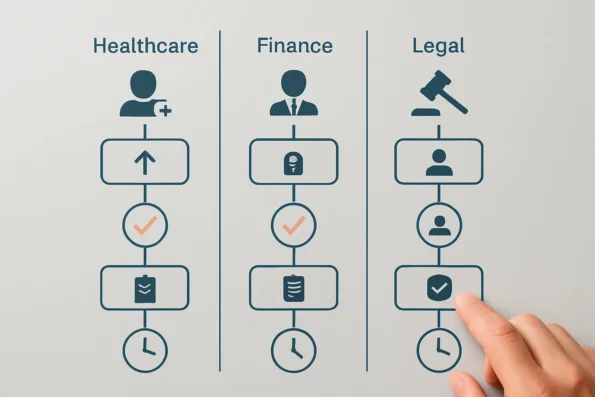
Finance: Financial sector workflows emphasize dual control and separation of duties. NextlerAI Publisher’s approval features enable content drafts to require review and sign-off by independent parties, reducing fraud and error risks. Role-based access restricts sensitive AI actions—such as publishing investment advice or regulatory disclosures—to authorized users. Logging creates a non-repudiable record of content changes, helping organizations demonstrate compliance with standards like GDPR and the EU AI Act. WordPress-native scheduling further supports controlled release windows for time-sensitive disclosures. In practice, a content item may move from a preparer to a compliance officer, then to a final approver, with each stage recorded in a tamper-evident log. This auditability is enhanced by configurable notification triggers, alerting stakeholders to pending reviews and required interventions.
Legal: Legal practices deploy NextlerAI Assistant with strict boundaries on knowledge sources to avoid unauthorized legal opinions. Publisher’s workflow is tailored for citation traceability: content drafts must pass through legal review, with references mapped to authoritative legal sources. Approval workflows enforce that only designated legal staff can authorize publication. Continuous system logging enables end-to-end traceability, essential for compliance with both the NIST AI Risk Management Framework and sector-specific legal ethics rules. Publisher can be configured to require explicit citation mapping prior to approval, and workflows may include automated policy checks to flag unsupported claims or missing references. All workflow actions, from drafting to publication, are captured in a persistent log accessible for both internal audits and external regulatory review.
Workflow Diagram Description
Each sector’s workflow diagram includes:
- Input stage: Content or knowledge submission by authorized staff.
- Review points: Multi-stage approvals (healthcare), dual sign-off (finance), or legal review (legal sector).
- Audit and logging: Automated recording of each action, review, and approval.
- Publication or response: Controlled release using WordPress scheduling, with the option for rollback or further review if compliance concerns arise.
- Escalation paths: Automated routing for content flagged during review, ensuring unresolved issues are addressed by compliance personnel before proceeding.
- Custom reviewer assignments: Assignment of specific roles to different workflow stages, supporting strict separation of duties and reducing the risk of unauthorized approvals.
Supporting Compliance via WordPress-Native Features
NextlerAI leverages WordPress-native scheduling and automation to align content and support actions with organizational compliance calendars and reporting cycles. Scheduled publishing ensures that no content goes live without full review. Workflow approvals and logging—documented in official product guides—enable organizations to demonstrate compliance through verifiable records, supporting audits and incident investigations. In regulated deployments, NextlerAI’s integration with WordPress cron jobs allows institutions to coordinate release schedules with externally mandated deadlines, while persistent logs ensure that every workflow action can be reconstructed and attributed to specific users.
By mapping workflow controls directly to sector-specific requirements, regulated organizations retain full oversight and flexibility in adapting NextlerAI to their operational and legal obligations. This modular, auditable approach supports both day-to-day operational needs and the exceptional scrutiny of regulatory audits or incident reviews, as detailed in official NextlerAI documentation.
Actionable How-To Steps for Regulated Industry Deployment
Deploying NextlerAI products in regulated sectors such as healthcare, finance, or legal services requires a disciplined, stepwise approach. The following implementation sequence provides a practical checklist for configuring, approving, and maintaining compliant AI deployments. Each action is grounded in product documentation and mapped to sector-specific regulatory requirements, ensuring that your organization maintains control, traceability, and oversight throughout the AI lifecycle. Teams designing regulated sector automation can benefit from understanding custom API integration strategies for tailoring NextlerAI deployments to strict compliance boundaries. Artificial Intelligence in Software as a Medical Device documents the relevant background and implementation boundaries.
-
Define Deployment Environment and Bind Licence to Production Domain
Assign each NextlerAI Assistant or Publisher instance to a specific environment—such as development, staging, or production. Bind the licence to the correct domain to enforce operational boundaries and prevent unauthorized use. This step is foundational for regulatory traceability, as required by frameworks like the NIST AI Risk Management Framework and the EU Artificial Intelligence Act. The environment assignment should be documented internally and reflected in deployment records for audit purposes.
-
Manually Enter and Validate AI Provider API Credentials
Do not embed API keys in generic configuration files. Instead, enter each credential directly within the secure WordPress interface and restrict their use to the intended environment. This manual control minimizes third-party exposure and aligns with sector privacy obligations, particularly in healthcare (as referenced by FDA guidance) and finance. Credentials should be rotated and reviewed periodically, and access to them should be limited to designated administrators only. Document the credential entry process and maintain a log of any changes or rotations.
-
Curate a Sector-Specific Knowledge Base With Explicit Inclusion and Exclusion Rules
Select only approved public-facing content, such as medical FAQs, legal disclaimers, or financial service information, for indexing by NextlerAI Assistant. Use WordPress knowledge base controls to exclude sensitive pages or data, defining precise content boundaries in accordance with jurisdictional requirements. Curated content lists and exclusion rules are essential for both transparency and compliance documentation. Maintain a change log for any modifications to knowledge base inclusion or exclusion settings, and periodically review content to ensure continued alignment with sector regulations. See official documentation for detailed curation controls.
-
Configure Role-Based Access and Restrict Actions According to Policy
Assign roles and permissions for each user interacting with NextlerAI products. Limit sensitive actions—such as publishing, responding, or updating knowledge bases—to authorized personnel only. Sector policies may require separation of duties or dual controls; ensure WordPress role assignments reflect these obligations and document all permission changes for audit readiness. Incorporate policy-driven permission mapping and review user access lists regularly to identify and remediate unauthorized privilege escalation.
-
Enable Comprehensive Audit Logging and Schedule Regular Compliance Reviews
Activate system logging features to capture all administrative actions, content updates, and workflow approvals. Establish a documented schedule for audit reviews, with logs stored securely according to your sector’s data retention standards. Regular review and reconciliation of logs are critical for demonstrating accountability under frameworks such as the EU AI Act and NIST AI RMF. Ensure logs are tamper-evident and include timestamps, user IDs, and action details to facilitate forensic reviews if needed.
-
Integrate Workflow Approvals and Documented Review Processes
For NextlerAI Publisher, require multi-stage editorial approvals before content goes live. In the case of Assistant, establish documented review procedures for knowledge base updates and AI-generated content. Approvals should be tracked within WordPress and cross-referenced with logged actions to provide a defensible compliance record. Define escalation paths for exceptions and ensure that review processes are revisited periodically to address regulatory changes. For implementation guidance, refer to Publisher Approvals documentation.
-
Maintain Version Control and Prepare Rollback Procedures for Safe Updates
Implement versioning for both knowledge base content and plugin software. Before applying updates, create backups and be familiar with documented rollback processes to restore previous states if issues arise. This is essential to minimize operational risk and maintain compliant configurations, as outlined in official NextlerAI guides. Store backup and rollback documentation in a secure repository accessible to authorized personnel. For detailed steps, consult NextlerAI rollback and recovery documentation.
By following these steps, your organization can establish a defensible, sector-aligned deployment of NextlerAI Assistant and Publisher. This framework not only supports compliance with current regulatory expectations but also offers the flexibility to adapt as sector standards evolve. The next section will demonstrate the practical application of these mechanisms within a regulated healthcare environment.
Illustrative Scenario: Deploying NextlerAI Assistant in a Regulated Healthcare Setting
Illustrative scenario: Consider a hospital’s IT and compliance team preparing to implement NextlerAI Assistant on their patient services portal. Their objective is to offer automated, accurate answers to frequently asked questions while maintaining strict adherence to HIPAA and institutional privacy mandates. This scenario demonstrates how NextlerAI’s configuration mechanisms can support a safe and compliant deployment in a regulated healthcare environment. For practical troubleshooting strategies, see the integration troubleshooting guide. To ensure a reliable transition, reference the CMS workflow integration steps outlined for NextlerAI Publisher when establishing controlled environments and audit trails.
1. Environment Initialization and Control Assignment
The team first isolates a staging environment using WordPress multisite. They bind the NextlerAI Assistant licence to the hospital’s official domain and manually input API credentials, ensuring keys are scoped solely to the intended environment. Only designated administrators receive credential access, supporting clear segregation of duties—a foundational control under the NIST AI Risk Management Framework and necessary for HIPAA compliance.
2. Curation of HIPAA-Compliant Knowledge Base
Knowledge source selection is guided by a privacy impact assessment: the team curates content exclusively from public patient FAQs, service descriptions, and policy documents that have undergone legal review. Sensitive records, internal notes, or unapproved clinical advice are explicitly excluded at the source configuration level. The Assistant’s knowledge boundaries are enforced using NextlerAI’s native controls, preventing inadvertent exposure of protected health information (PHI).
3. Role-Based Permissions and Action Restrictions
Administrative policies dictate that only compliance-approved staff can alter the knowledge base or activate new live chat actions. The IT team configures granular permissions, limiting the Assistant’s capabilities to predefined answer sets and disabling any freeform actions that could trigger workflow or data extraction beyond what hospital policy permits. This step supports both traceability and minimization of regulatory risk.

4. Approval Pipeline and Human Oversight Integration
Before the Assistant is published site-wide, a multi-stage approval pipeline is enacted. Content updates and configuration changes are routed through compliance and medical information officers, each step captured in an audit log. No response or system behavior goes live until approved, satisfying both the traceability requirements outlined in the EU Artificial Intelligence Act and the FDA’s expectations for human oversight in AI-driven patient communication tools.
5. Systematic Logging and Version Rollback
Operational logging is enabled for every interaction and configuration change. If a knowledge base update is later found to introduce a compliance risk (such as an outdated consent policy), the team uses documented rollback procedures to revert to a trusted version, minimizing exposure and ensuring compliance continuity. Regular log reviews and version audits are built into ongoing operational policy, as recommended in official NextlerAI troubleshooting and security guidance.
6. Decision Points: Live Chat Controls and Privacy Guardrails
When deciding whether to activate live chat handoff to human agents, the compliance team reviews whether such actions could potentially lead to PHI exposure. If uncertainty remains, the feature is left disabled until additional safeguards—such as explicit consent capture or further access controls—can be validated. This approach ensures that AI-powered automation never exceeds the boundaries set by healthcare privacy regulation.
7. Ongoing Troubleshooting and Compliance Assurance
If operational issues or compliance questions arise, systematic logs enable efficient root-cause analysis and documentation for internal and external audits. Should configuration drift or knowledge base errors occur, the team relies on NextlerAI’s built-in version control mechanisms to restore a compliant state rapidly. These troubleshooting practices are central to sustained regulatory alignment and operational resilience.
This scenario, while hypothetical, reflects how regulated healthcare organizations can leverage NextlerAI Assistant’s documented feature controls to meet sector-specific obligations for privacy, traceability, and oversight—without compromising on automation or patient service quality.
FAQ
What does NextlerAI regulated industry implementation involve?
Implementing NextlerAI in a regulated sector means configuring all deployment aspects to comply with legal and operational mandates for data privacy, access control, and auditability. This includes binding licences and API keys to your production domain, curating the knowledge base to exclude prohibited or sensitive content, defining granular user permissions, and enforcing structured review and approval workflows. Each mechanism must be explicitly aligned with sector-specific obligations before the system is activated in a production environment.
Which compliance considerations are critical for AI deployment in healthcare, finance, or legal sectors?
The most critical considerations are data privacy enforcement, traceability of every AI-driven action, separation of duties via role-based access, and documented human oversight. Sector-specific frameworks—such as HIPAA for healthcare, EU AI Act for finance and legal, and FDA guidelines for medical software—require transparent configuration, robust access controls, and persistent audit logging to demonstrate ongoing compliance and facilitate regulatory review.
How do NextlerAI Assistant and Publisher map to regulated environment needs?
NextlerAI Assistant supports multilingual, permission-based sales and support on WordPress/WooCommerce, with the ability to restrict knowledge domains and user actions as required by compliance policies. NextlerAI Publisher manages structured content creation and workflow approvals, ensuring that every content item passes through mandatory review and scheduling steps. Both products require manual configuration for environment, credentials, and scope to enforce regulatory boundaries.
What are the stepwise actions for safe, compliant rollout?
The essential steps are: assign the deployment environment, bind product licences and API keys to your production domain, curate the knowledge base to sector policy, set granular permissions for all user roles, enable detailed logging, implement multi-stage approval pipelines, and schedule regular access and audit reviews. Document rollback and credential rotation protocols to support incident response and change management in regulated settings.
How does the implementation process differ across regulated sectors?
Healthcare deployments must prioritize exclusion of patient-identifiable information and enforce HIPAA-compliant knowledge boundaries. Finance implementations require dual controls, granular audit trails, and strict separation of editorial and approval functions. Legal sector rollouts emphasize traceable citation mapping, reviewer assignment, and policy-driven action enablement. Each sector’s process is defined by its regulatory obligations, which shape the configuration and oversight checkpoints of the deployment.
What troubleshooting or oversight mechanisms are required for ongoing compliance?
Ongoing compliance relies on frequent reviews of audit logs, validation of access permissions, and regular knowledge base updates aligned with regulatory changes. Troubleshooting involves systematic log analysis, version rollback if unauthorized changes are detected, and escalation via structured approval paths. Persistent oversight ensures that the AI environment remains traceable, policy-compliant, and ready for external audit or incident response at any time.
Conclusion
Adopting NextlerAI in regulated sectors demands a methodical, controls-driven approach that aligns technology with the reality of legal responsibility and operational oversight. The sector-specific configuration of access, knowledge boundaries, and workflow approvals is not just a technical exercise—it is the foundation for achieving and demonstrating compliance under frameworks such as the NIST AI Risk Management Framework, the EU Artificial Intelligence Act, and the FDA’s AI/ML guidance.
Robust compliance relies on explicit assignment of roles, careful documentation, and the development of operational processes that bridge IT and governance needs. Technical leads must coordinate closely with compliance officers to define which data sources and workflows are permitted, ensuring that only authorized personnel can trigger sensitive actions or alter curated knowledge bases. Traceability must be enforced by activating detailed system logging and by mandating reviews of approval trails. In regulated environments, this level of coordination prevents accidental policy breaches and supports defensible audit outcomes if regulatory scrutiny arises.
For IT and compliance leaders, the most effective next step is to initiate a joint review involving both technical and compliance stakeholders. Convene a cross-functional session to map your current environment, document regulatory touchpoints, and assign precise roles for knowledge base curation, approval chain configuration, and audit oversight within NextlerAI. This collaborative mapping will clarify control gaps and establish a clear deployment pathway tailored to your sector’s obligations.
Continuous oversight is essential. Establish a schedule for routine log reviews, permission audits, and knowledge base updates to ensure your NextlerAI deployment remains aligned with evolving legal standards and organizational policies. This ongoing governance transforms technical settings into sustainable compliance assurance.