







Introduction
AI content research automation transforms early-stage content strategy by rapidly surfacing relevant topics, revealing competitor activity, and streamlining keyword research. For content strategists, SEO professionals, and digital marketing teams, adopting automated workflows can dramatically scale research efforts—while preserving oversight and quality when implemented thoughtfully. Understanding how these systems operate, where true automation begins and ends, and how to maintain editorial control is critical for sustainable, high-impact publishing.
This article offers a practical roadmap to evaluate, implement, and optimize AI-driven research pipelines. You will learn how advanced tools—such as those using structured editorial workflows—automate discovery and planning without sidelining human judgment. We will clarify which processes can be reliably delegated to AI, where manual review remains essential, and how features like inventory control protect against duplication and topic cannibalization. Expect myth-busting analysis, workflow comparisons, and clear decision criteria grounded in real product documentation, not generic promises.
By the end, you will be equipped to assess automation solutions, avoid common pitfalls, and integrate AI-powered research into your content operation with confidence and transparency. The next section addresses the limits and risks of AI research automation before guiding you through evidence-based workflows and decision steps.
Modern AI research automation does not simply replace human input; instead, it augments your strategic process by providing structured data and actionable insights at scale. Systems capable of inventory and topic scoring—such as those documented in enterprise content platforms—require precise configuration to match editorial standards, and must be aligned with compliance controls from the outset. Teams remain responsible for evaluating AI-generated suggestions, ensuring that topics align with organizational goals, and upholding data privacy when handling user or market data. With transparent governance and clearly defined review steps, AI-driven research can deliver meaningful productivity gains while safeguarding against redundant or misaligned content creation.
| Section | Description |
|---|---|
| Expert caution: limits and risks of AI content research automation | Clarifies boundaries and governance issues before deploying automation |
| Workflow table: how AI research automation pipelines operate | Contrasts manual and automated research processes step by step |
| Decision criteria: comparing automated research approaches | Defines evaluation metrics for selecting the right tool or workflow |
| Definitions: clarifying research automation terms | Establishes key terms to avoid misinterpretation |
| Decision steps: implementing automated research pipelines | Outlines actionable steps for configuring and monitoring automation |
| Conclusion | Synthesizes key decisions and next actions |
| FAQ | Provides concise answers to the top reader questions |
Expert caution: limits and risks of AI content research automation
Before introducing AI automation into your content research processes, it’s critical to recognize both its acceleration potential and its inherent limitations. While AI can streamline topic ideation, competitor mapping, and keyword identification, it cannot independently ensure that research aligns with editorial standards, strategic objectives, or brand voice. Automated systems must be configured deliberately and never left to operate without clear human governance. When considering the limits of automation, reviewing recent insights on AI workflow automation tools helps clarify where human oversight is essential. Understanding the specifics of NextlerAI Publisher CMS integration is crucial for teams aiming to align automated research pipelines with existing editorial and inventory controls. When automating AI-driven content research, organizations must be aware that the EU AI Act risk-based obligations establish compliance requirements based on the assessed risk level of AI systems.
Why human oversight is non-negotiable
Unchecked automation poses substantial risks. AI-generated outputs are only as reliable as their inputs, workflows, and controls. Without editorial review, automated research can propagate factual errors, duplicate existing site topics, or unintentionally introduce bias. For example, an AI tool left to suggest and queue topics without explicit editorial approval risks flooding your pipeline with overlapping or redundant ideas, undermining both SEO effectiveness and team efficiency.
Inventory controls and cannibalization prevention
Safeguarding originality and topic distinctiveness is essential in any automated pipeline. Inventory management mechanisms—such as those found in structured editorial tools—must be used to track which topics have been proposed, approved, or published. Failing to monitor and validate inventory can lead to content cannibalization, where multiple articles compete for similar keywords or audience intent. This not only dilutes ranking potential but can erode site authority and confuse readers. Approval steps, queue management, and deduplication checks are not optional add-ons; they are mandatory for responsible automation.
Compliance, privacy, and regulatory obligations
Automating research in regulated environments introduces an additional layer of responsibility. Organizations operating in or serving the European Union must evaluate workflows under the obligations defined by the EU AI Act, which distinguishes risk levels and controller responsibilities for AI deployments. Similarly, U.S. teams should reference the NIST AI Risk Management Framework, which provides a structured approach to identifying, assessing, and mitigating risks in AI systems, including content research pipelines. These frameworks mandate due diligence in data privacy, transparency, and auditability—especially where personally identifiable information or proprietary data may inform research outputs.
Editorial accountability and governance
AI automation does not absolve teams of governance obligations. Editorial sign-off, documented topic strategy, and transparent approval trails remain central. Systems such as workflow automation tools can enforce these steps, but only when configured with explicit checkpoints. The absence of human review can result in misalignment with organizational objectives or regulatory non-compliance. It is essential to assign clear roles for reviewing and approving AI-generated research to maintain quality and accountability throughout the process.
Deeper pitfalls: bias, drift, and unintended propagation
Deploying AI-driven research automation introduces the risk of amplifying systemic bias or allowing content drift over time. AI models, even when used for research acceleration, reflect the biases of their training data and input sources. If editorial teams delegate research without structured review, subtle inaccuracies or biased perspectives may be propagated at scale. This can inadvertently reinforce stereotypes, exclude minority viewpoints, or misrepresent complex topics. Unchecked automation may also lead to content drift—where repeated, unsupervised iterations gradually move topics or recommendations away from the intended organizational strategy or voice. Mitigating these risks requires routine audits and clear documentation of decision-making rationales, as well as periodic recalibration of both automation parameters and editorial standards to ensure continued alignment.
Decision boundaries and approval checkpoints
Effective implementation of AI research automation hinges on the explicit separation of automated and manual decision points. Teams must define where automation ends and human judgment begins. For example, topic scoring and initial clustering may be automated, but final inclusion in the editorial calendar should remain a human responsibility. Approval checkpoints should be codified within the workflow, with audit logs detailing who approved each topic and on what basis. This level of granularity not only enhances accountability but also provides a defensible record for compliance reviews or internal quality assessments.

Expert responsibility in system configuration
Ownership of AI automation outcomes is inseparable from the expertise embedded in system configuration. Experts must select input sources, tune topic relevance thresholds, and establish deduplication logic to minimize overlap. They should also create clear escalation protocols for ambiguous or high-impact topics, ensuring that edge cases or outliers are subject to additional scrutiny. Decisions about integration with external data, use of proprietary versus public sources, and the balance between automation scale and review depth all require nuanced, ongoing oversight by experienced professionals. Failing to invest in this upfront and continuous configuration undermines the very efficiencies automation seeks to deliver and exposes teams to reputational and compliance risks.
With these risks and boundaries clearly understood, teams are better prepared to evaluate the workflow and decision criteria that underpin automated content research pipelines.
Workflow table: how AI research automation pipelines operate
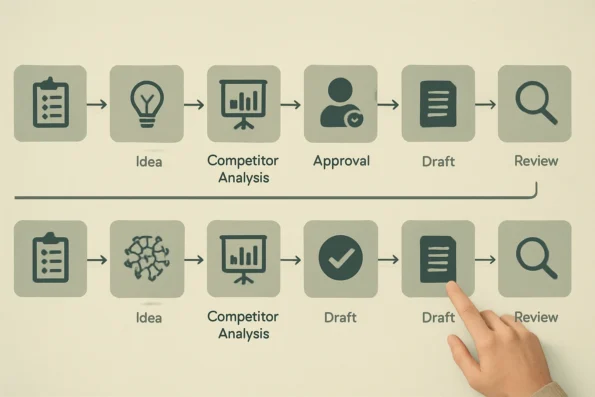
Understanding the distinction between manual and AI-supported content research workflows is essential for scaling topic discovery, competitor analysis, and editorial planning. As organizations grow, the complexity of managing content strategy increases, making workflow design and explicit process controls critical for quality and compliance. The following table provides a side-by-side comparison of each major phase—from ideation to publication—highlighting responsible parties, handoff points, required controls, and potential risks. This framework clarifies where automation streamlines production and where human review remains indispensable, based on documented features, configurations, and governance points from current AI publishing platforms. For a practical view of automation in action, the Publisher setup guide details each step from activation to content generation within a real workflow. In research automation workflows, AI automation tools increase efficiency by streamlining steps such as data extraction, screening, and synthesis.
| Phase | Manual Workflow | AI-Automated Workflow (e.g., NextlerAI Publisher) | Responsible Parties | Risks & Required Controls | Source |
|---|---|---|---|---|---|
| Content Inventory Build | Manual audit of existing content and mapping of coverage gaps | Automated indexing of WordPress posts, pages, products, and custom types; overlap detection | Editor, strategist, AI tool | Missed duplicates or outdated inventory if not regularly checked | NextlerAI Publisher complete guide |
| Topic Ideation & Discovery | Brainstorming, manual competitor review, and keyword research with multiple tools | Automated topic proposal via strategy fields, clustering, and scoring based on site inventory and model context | Editor selects, AI proposes | Unfocused or irrelevant topics without correct configuration and review | Publisher Topic Manager and Smart Topic Strategy |
| Competitor & Keyword Analysis | Manual collection and interpretation of SERP results, keyword volumes, and competitor articles | Optional AI-driven scoring and context using integrated services (e.g., Search Console, Serper); not required for core workflow | Editor configures, AI aggregates | Over-reliance on automated context can lead to missed nuances; editorial review required | Publisher Search Console OAuth, Serper research and multilingual sites |
| Topic Approval | Manual vetting and prioritization by editorial team | Editor reviews, approves, or amends AI-scored topic proposals in a queued interface before article generation | Editor | Bypass of this step risks low-quality or redundant content | NextlerAI Publisher complete guide |
| Draft Generation | Original writing or assembly based on research; drafting and sectioning by author | Automated draft produced from approved topic, with structured sections and embedded internal links | AI generates, editor reviews draft | Insufficient fact-checking or structural issues if editorial review is omitted | Publisher: complete setup from activation to first article |
| Publication Scheduling | Manual slot management, calendar tracking, and status updates | Native WordPress slot reservation and scheduled auto-publish, with pause and approval hold options | Editor sets policy, AI enforces slots | Unintended publication if quality blockers or holds are not configured | Publisher automation, native WordPress scheduling, approvals and cron |
| Editorial Review & Compliance | Final manual review for accuracy, brand voice, SEO, and compliance | Required editorial checkpoint before release; automated outputs flagged for manual signoff | Editor | Compliance and factual errors if review is skipped; regulatory responsibility remains with deployer | AI Act | Shaping Europe’s digital future |
Each workflow phase benefits from automation by reducing repetitive manual effort, but every automated handoff introduces potential risks. The underpinning mechanism of these pipelines depends on clear API integrations, inventory scanning, and configured handoff points—where the AI system automatically updates the content inventory, proposes topics based on real-time analysis, and enforces queue-based approvals. Editors must deliberately set strategy fields, scoring parameters, and publication slotting rules to prevent unintended overlap or unsanctioned publication. Optional integrations, such as with search analytics or multilingual support, require explicit activation and ongoing monitoring. Inventory controls, topic approvals, and editorial review act as critical safeguards—ensuring that automation accelerates research without compromising quality, compliance, or strategic direction. As automation increases throughput, organizations must invest in workflow transparency, reviewer training, and audit trails to sustain alignment with editorial standards and regulatory requirements.
Decision criteria: comparing automated research approaches
When evaluating AI content research automation, teams need to distinguish between tools that promise convenience and those that deliver operational reliability under real editorial constraints. The most effective solutions address both workflow integration and transparency of underlying research logic, ensuring every automation step aligns with business and compliance requirements. The article on AI editorial workflow automation provides additional criteria for evaluating automation approaches in editorial environments.
Integration with existing content management systems (CMS) is a foundational criterion. Tools natively embedded into platforms like WordPress, such as NextlerAI Publisher, enable research automation directly within established editorial pipelines. This approach reduces manual exports or imports, minimizes context switching, and ensures topic queues, approvals and inventory checks remain visible to editors and strategists at every stage. In contrast, standalone platforms may create additional friction, requiring duplicate data entry or breaking key handoffs between research and production teams.
Transparency and control over topic scoring are equally critical. Automation that surfaces how topics are scored, prioritized, and filtered—based on inventory, strategy fields, or competitive analysis—empowers editors to validate that research recommendations support genuine business objectives. Documented workflows, such as those in NextlerAI Publisher, make strategy fields and scoring logic explicit, offering clear checkpoints for approval or adjustment before content generation begins.
Robust inventory management is another differentiator. Teams should assess whether a tool actively audits the existing content inventory to prevent overlap, cannibalization, or accidental duplication. Systems with built-in deduplication and conflict prevention, as found in some WordPress-integrated pipelines, reduce the risk of generating near-duplicate topics or undermining search engine performance. Not all research automation platforms offer this capability—manual audit remains necessary if inventory controls are lacking.
Support for evidence-based research distinguishes mature automation workflows from generic keyword suggestion engines. Capable solutions allow editors to verify sources, incorporate optional external signals (such as Search Console data or third-party research APIs), and attribute insights transparently within the editorial process. When evidence or multilingual requirements are integral to the strategy, ensure the tool records sources, handles language-specific context, and does not simply aggregate surface-level topics without attribution.
Editorial approval controls are non-negotiable for organizations subject to quality standards or compliance frameworks. Automation must never bypass required checkpoints or publish unvetted research. Look for systems that embed configurable approval states, generation blocks, and scheduled publication only upon explicit editorial signoff. In environments handling high content volumes or multiple languages, this ensures accountability remains with designated reviewers, not the automation layer.
It is also crucial to evaluate how customizable the automation workflow is, particularly regarding inventory strategy, topic qualification, and evidence inclusion. Tools should offer granular configuration: for example, enabling the use of taxonomy fields, content scoring parameters, and multilingual settings tailored to the organization’s editorial policy. Solutions such as NextlerAI Publisher document these strategy fields and allow teams to define approval gates—ensuring that only research satisfying agreed criteria proceeds to the next pipeline stage. This supports nuanced decisions, like prioritizing topics based on competitiveness, relevance to inventory gaps, or specific business objectives.
Further, teams should investigate the visibility into audit logs and activity tracking provided by the tool. Reliable automation platforms enable traceability of research decisions, approvals, and topic allocations, which is essential for both internal governance and external compliance requirements. The ability to review and audit the progression of topics from suggestion through to publication underpins trust in the automation process and supports post-publication analysis.

Finally, consider how the solution manages collaboration between multiple stakeholders. Effective research automation should not isolate editorial, SEO, and compliance teams; rather, it must enable controlled handoffs, shared review states, and adjustable permissions. This ensures that research proposals benefit from collective expertise, while also guarding against unintentional publication or loss of accountability. Features such as queue management, role-based approvals, and inventory slotting—as evidenced in WordPress-integrated workflows—directly support these requirements and reduce operational risk.
Ultimately, the decision to adopt any research automation approach should be grounded in a practical comparison of tool capabilities with organizational needs. Begin by mapping critical requirements—such as CMS integration, workflow transparency, inventory management, evidence support, and review controls—then match these to verifiable features in shortlisted platforms. Avoid tools that promise full automation without clear guardrails or documented approval mechanisms, as these introduce avoidable operational and compliance risks. The next section will clarify the definitions and boundaries that underpin responsible research automation.
Definitions: clarifying research automation terms
For content strategists and editorial teams adopting AI content research automation, using precise terminology is essential to avoid missteps and ensure effective governance. Below are core definitions and their operational boundaries, grounded in current AI content research workflows and documented platform features. To understand the precise boundaries of research automation, reviewing the Publisher Topic Manager documentation clarifies key terms and field behaviors. A common architecture for topic discovery in research automation is the BERT transformer-based model, which enables deep bidirectional understanding of language.
Topic discovery
Topic discovery is the process of identifying relevant, original subjects for content creation. In editorial automation, AI can accelerate and broaden topic ideation by analyzing existing content, competitor landscapes, and search demand. However, this process remains semi-automated: the identification of promising topics is expedited, but final decisions on originality, strategic alignment, and brand fit require human review. For example, in systems such as NextlerAI Publisher, AI proposes topics using structured strategy fields, yet editors must review queued topics before generation advances. Mechanistically, AI models can process large volumes of site content and external data sources, extracting potential themes and surfacing them for editorial assessment. These suggestions may be ranked or clustered according to the configured strategy, but the platform prohibits bypassing manual approval. The human role includes verifying the distinctiveness of each topic, assessing its fit with editorial goals, and modifying or excluding topics as needed.
Research automation
Research automation refers to the use of AI-driven tools to collect, score, and queue research inputs—such as keywords, competitor topics, or supporting evidence—into an editorial workflow. This automation reduces manual effort at the intake stage but does not eliminate the need for editorial judgment. AI models can surface new insights, rank potential topics, and flag content gaps, but all recommendations are queued for human validation before further use. In verified workflows, AI does not autonomously approve, draft, or publish research outputs without explicit intervention. Implementation decisions include selecting which data sources are enabled (such as Search Console or third-party research APIs), configuring the weighting of scoring factors, and specifying which user roles can review or promote queued research. Editorial teams must also determine how automated research aligns with their factual standards and attribution requirements, ensuring that only validated insights enter later production phases.
Inventory control
Inventory control encompasses the mechanisms that prevent content duplication, manage topic allocation, and maintain a clean editorial pipeline. Automated inventory controls—such as those enabled by Publisher’s strategy fields and scoring—analyze all existing eligible content types (posts, pages, products) to avoid cannibalization or overlap. This includes reading titles, headings, taxonomy, and SEO metadata to detect near-duplicates or previously covered topics. Mechanisms also extend to the automated flagging of topics that conflict with established strategy fields, such as target intent or cluster assignment. Effective inventory control requires continuous synchronization between automated research queues and the evolving published corpus, ensuring each new topic is distinct, strategic, and non-redundant. Implementation may involve setting up inventory scans on content creation or update events, defining exclusion rules for certain content types, and using platform-level deduplication logic. Editors oversee these controls, reviewing flagged overlaps and making final determinations on topic eligibility.
Approval workflow
An approval workflow defines the human-in-the-loop steps where editors or content managers vet, adjust, or reject AI-generated research and proposed topics before content creation proceeds. Approval is not a passive gate: it may involve refining topic phrasing, excluding unsuitable candidates, or assigning topics to specific editorial clusters. In platforms with structured automation, approval states are explicit—no topic enters the generation or scheduling phase until it passes these review checkpoints. Approval workflows are critical for compliance, brand integrity, and quality assurance in automated pipelines. Editorial ownership of the approval state ensures that every topic is traceable to a human decision, with audit trails documenting the who, when, and why behind each approval or rejection. Teams may configure branching approval paths for multilingual sites or specialized content clusters, ensuring that only authorized roles can progress topics through the pipeline.
Clarification of boundaries
AI research automation can automate the intake, scoring, and queuing of topics and research inputs, but it does not autonomously approve, generate, or publish content. All automated actions are constrained by configured checkpoints—editors must confirm any topic or research input before it progresses. This division maintains operational oversight and ensures that automation augments, rather than overrides, human expertise. The line between automation and manual review is enforced through platform settings, audit trails, and required approvals, preventing accidental publication or strategic drift. The boundary is further reinforced by system permissions and role assignments—for example, restricting topic advancement or publication rights to senior editors or content managers. These controls ensure that compliance, editorial intent, and organizational governance are preserved at every stage of the research and content pipeline.
Clear, shared definitions underpin reliable research automation. By formalizing how topic discovery, research automation, inventory control, and approval workflows operate—and by embedding these boundaries in platform configuration—organizations safeguard against misinterpretation, loss of editorial control, and compliance lapses. This clarity is foundational before teams proceed to implementation decisions, which are addressed in the next section.
Decision steps: implementing automated research pipelines
Operationalizing AI content research automation requires a methodical, staged approach to ensure quality, compliance, and editorial alignment. The following ordered steps provide a practical pathway for teams to implement automated research pipelines while retaining oversight and adaptability throughout the process. Integrating content strategy and inventory controls is essential before implementing any automated research pipeline.
- Audit your existing content inventory. Begin by mapping all current posts, pages, and eligible content types to identify coverage gaps, topic overlap, and areas at risk of cannibalization. Reliable automation tools, such as those documented for WordPress, can parse titles, main content, headings, taxonomy terms, and SEO keywords to establish the boundaries of your live inventory. In platforms like NextlerAI Publisher, the inventory audit draws on structured data within the CMS, providing a factual basis for deduplication and topic gap detection. This step is essential for minimizing redundant coverage and ensuring the pipeline operates on a clear, current editorial map. Teams should also establish rules for inventory synchronization, ensuring that new or updated content is promptly indexed and that taxonomy changes trigger re-audits to maintain alignment with strategic priorities.
- Configure your research automation environment. Install and activate your chosen AI content research automation tool. Connect supported language models and set up inventory controls, including strategy fields and topic scoring mechanisms. These configurations guide the AI to propose topics that align with your editorial strategy and prevent duplication. Implementation detail at this phase includes setting taxonomy filters, defining scoring thresholds for topic relevance or originality, and mapping strategy fields to organizational priorities such as audience segment, funnel stage, or multilingual context. Advanced implementations may involve scripting strategy field logic to dynamically adjust topic recommendations based on seasonality, campaign goals, or cross-departmental input. Accurate configuration at this stage directly influences the precision and usefulness of AI-generated topic proposals.
- Define editorial review checkpoints. Establish clear approval workflows so that every proposed topic or research input is vetted by human editors before content generation or publication. Assign responsibility for topic selection, escalation of conflicts, and final sign-off on queued topics. This ensures only strategic, non-duplicative topics proceed to the next stage. In tools like NextlerAI Publisher, editorial checkpoints are integrated into the workflow through status fields, review queues, and permission controls, enabling granular oversight. Editors must decide on escalation protocols for edge cases—such as overlapping topics flagged by inventory checks or ambiguous keyword matches—and document rationales for approvals or rejections. Teams should formalize these checkpoint procedures in their editorial guidelines, specifying criteria for when to reject, merge, or escalate topics, and defining audit trail requirements for compliance and future reference.
- Integrate evidence-backed research and internal linking procedures. Enable relevant integrations, such as source-backed research enrichment and multilingual support, to enhance the depth and diversity of generated content. Internal linking logic should be included in the pipeline to reinforce site structure and topical authority, and all source evidence must be reviewable by editors. Depending on the chosen platform, this may involve activating citation importers, configuring language settings, or defining internal link templates. These mechanisms support compliance with editorial standards and regulatory requirements, particularly where factual backing or multilingual accuracy is mandated. Editorial teams should also define protocols for validating imported evidence and for updating internal linking patterns as new cornerstone or cluster pages are created within the inventory.
- Monitor for duplication, quality, and compliance continuously. After initial rollout, actively review generated content for inadvertent overlaps, factual errors, or non-compliance with regulatory standards. Adjust strategy fields, inventory controls, and approval settings as new patterns or edge cases emerge, maintaining a regular cadence of quality audits. Publisher tools for WordPress support iterative adjustment and inventory checks at each pipeline stage. This ongoing review cycle should be documented, with clear roles for who initiates audits, addresses flagged issues, and updates the configuration as the content corpus evolves. Teams are encouraged to implement periodic, cross-functional reviews—bringing together editorial, compliance, and technical leads—to assess output integrity and refine workflow parameters in line with changing business objectives and regulatory conditions.
By following these ordered steps, teams can implement automated research pipelines that accelerate content operations while preserving the control, transparency, and editorial integrity required for sustained success. The next section addresses the most frequent technical and operational questions teams encounter during this transition.

FAQ
What risks should teams consider before automating content research with AI?
Teams must account for the potential propagation of factual errors, bias amplification, and the creation of near-duplicate or overlapping content. Without structured inventory controls and periodic editorial review, automated pipelines can inadvertently introduce topic cannibalization, reduce originality, and undermine compliance. Regulatory frameworks, such as the EU AI Act and NIST AI Risk Management Framework, require organizations to maintain oversight and document decision points throughout the research automation process.
How do AI tools automate the topic discovery and research pipeline?
AI tools accelerate topic discovery by analyzing large sets of existing content, identifying thematic gaps, and clustering related subjects based on documented scoring criteria. They can automatically queue topics for review, integrate optional multilingual or external evidence, and filter potential overlaps. The research pipeline is configured to flag conflicts, route proposals to human approvers, and only generate content after explicit signoff at defined checkpoints.
What decision criteria matter most when selecting an AI content research tool?
Key factors include: transparent integration with the existing CMS, control over inventory deduplication and topic scoring, support for multilingual evidence, configurable approval workflows, and traceable audit logs. Teams should prioritize tools that enable role-based permissions and enforce quality gates. The ability to synchronize with up-to-date content inventory and prevent content cannibalization is critical for operational reliability.
Which definitions clarify the boundaries of AI automation versus manual research?
AI automation refers to the structured sourcing, scoring, and queuing of topics and research data, all subject to human review. Manual research involves direct human analysis and approval at each stage. Automation can rapidly assemble and pre-screen candidates, but human editors retain responsibility for final approval, compliance verification, and content quality before publication. Explicit checkpoints distinguish automated handoffs from required editorial oversight.
What are the recommended steps to implement automated AI content research in practice?
Begin by auditing and synchronizing your content inventory to map gaps and overlaps. Configure the automation tool with defined strategy fields and scoring logic. Set up approval workflows, ensuring every topic or research proposal is reviewed before content generation. Integrate multilingual and evidence-based research options as needed. Monitor output for duplication and compliance, making iterative adjustments to maintain alignment with organizational objectives.
Conclusion
Adopting AI content research automation demands more than simply enabling new tools. The most effective teams treat automation as an extension of their editorial discipline—configuring systems to fit their existing review cycles, inventory controls, and approval policies. When automation is grounded in clearly defined strategy fields and audit trails, as documented in leading platforms, it supports scale without eroding trust or accuracy.
To ensure long-term success, implementation must be a collaborative process between technology leads and editorial managers. This includes setting explicit permissions for what AI-driven actions are allowed, mapping out escalation protocols for unresolved conflicts, and establishing version-controlled logs of each editorial decision point. Teams should also define clear criteria for when AI-suggested research enters or exits the workflow, integrating routine reviews for data drift, inventory mismatches, or compliance triggers. This disciplined oversight prevents system drift and reinforces accountability even as automation scales.
For teams prepared to move forward, the immediate priority should be a structured pilot. This means defining a test scope, configuring pipeline checkpoints, and establishing clear roles for oversight. Begin with a manageable segment of your content inventory to validate how automation integrates with your editorial queue and quality benchmarks. This targeted approach reveals workflow strengths and exposes gaps before scaling up, allowing for controlled optimization and compliance alignment.
Ultimately, successful AI content research automation is defined by transparent integration between technology and human expertise. When systems are configured for oversight and adaptability, organizations can achieve significant efficiency gains while maintaining the editorial standards that underpin their credibility and long-term value.