







Introduction
AI editorial workflow automation is transforming how content teams manage approvals, scheduling, and consistency across complex publishing pipelines. For organizations handling large volumes or multi-author environments, automation streamlines repetitive steps—such as routing content for review, managing draft states, and scheduling publication slots—all while ensuring operational control remains in human hands. By leveraging documented features of platforms like NextlerAI Publisher, content managers can automate routine tasks, minimize manual bottlenecks, and enforce quality gates without sacrificing oversight.
This article is designed to give you clear, practical guidance on implementing AI-driven editorial workflow automation at scale. You’ll learn how to map the boundaries of automation, follow proven diagnostic steps for safe setup, and establish effective risk controls. Whether your goal is to improve consistency, accelerate turnaround, or coordinate a distributed editorial team, you’ll gain actionable insight into what current AI automation platforms can—and cannot—reliably deliver in real publishing environments. The following sections provide a working roadmap for safe, effective editorial workflow automation tailored to enterprise needs.
By understanding the foundational mechanisms behind automation—such as rule-based scheduling, explicit approval routing, and automated eligibility checks—readers will be equipped to make informed decisions about which editorial processes can be confidently delegated to AI and which require persistent human oversight. The article draws directly from platform documentation and operational guides, ensuring that recommendations are grounded in verifiable product capabilities. As you proceed, you will discover how to balance automation efficiency with editorial safety, unlocking scalable workflows while maintaining the standards critical to your publishing objectives.
- Limitations of AI Editorial Workflow Automation
- Diagnostic Steps for Safe Editorial Workflow Automation
- Risk-Control Table: Ensuring Editorial Consistency and Safety
- Conclusion
- FAQ
Limitations of AI Editorial Workflow Automation
AI editorial workflow automation provides a structured framework for handling repetitive, rules-based tasks—such as managing scheduled publication slots, routing articles for approval, and enforcing draft status policies. However, its effectiveness depends on explicit configuration and well-defined editorial rules. AI systems cannot interpret nuanced editorial context, subjective quality judgments, or evolving brand guidelines without direct human input. This makes clear policy design and active oversight a necessity, not an option. For a side-by-side workflow automation tool comparison focused on editorial teams, see the in-depth guide at this link. Think Topics | IBM documents the relevant background and implementation boundaries. [2006.01700] Radio morphology of southern narrow-line Seyfert 1 documents the relevant background and implementation boundaries.
Boundaries of Automated Approvals and Slot Management
Automated approval routing in platforms like NextlerAI Publisher is limited to predetermined states: articles can be auto-published, left as drafts, or marked as pending review according to the configured workflow. However, content flagged by quality blockers, licensing restrictions, or system-level warnings cannot bypass human intervention. Publisher’s slot and review logic ensures that only articles passing all eligibility checks proceed automatically; those that trigger warnings or fall outside quality thresholds require editorial review before moving forward. This safeguard helps maintain baseline quality, but also highlights the operational dependency on human decision-making for exceptions and edge cases.
Mechanistically, NextlerAI Publisher’s automation relies on explicit rule definitions. For example, the system will evaluate each article’s metadata, quality rule compliance, and licensing state before determining eligibility for a publication slot. If an article fails any automated check, it is withheld from auto-approval and flagged for manual attention. This architecture ensures clear separation between what the AI can enforce (rules-based eligibility) and what it cannot (judgement-based exceptions). The workflow logic is transparent and auditable, but cannot adapt to new or ambiguous requirements without manual reconfiguration. (See published documentation).
Scheduling Constraints and Content Eligibility
Scheduling automation, including interval-based publishing and integration with WordPress cron, offers efficiency gains for large pipelines. Still, its scope stops at what is explicitly eligible and quality-approved. If a publication slot is missed or the system is paused, the scheduler will only select from articles that have met all predefined requirements. It cannot generate substitute content or compensate for a lack of ready material. This restriction underscores the importance of proactive topic management and manual intervention to avoid gaps in scheduled publishing.
In practice, automated schedulers depend on a queue of approved, eligible articles. When a slot is due, the system checks for available content that meets all criteria—such as passing all quality rules and being free of unresolved blockers. If none are available, the slot remains empty; no new content is generated or substituted automatically. This approach prevents accidental publication of unvetted material but requires editorial teams to maintain a sufficient pipeline of pre-approved articles to achieve uninterrupted schedules. Cron integration automates only the timing aspect, not the creative or review process.

Version Control and Irrecoverable Errors
Version management in most AI editorial platforms—including Publisher—centers on draft states and event logs rather than full, revertible version histories. While these tools document key actions and workflow changes, they do not provide comprehensive rollback. If an error leads to content loss or unwanted publication, manual backups remain the only reliable recovery method. Teams must treat automated logs as a supplement, not a substitute, for robust backup protocols.
The practical implication is that, in the event of accidental overwrites or deletions, recovery depends on external backup systems rather than built-in undo features. Version logs can trace when and by whom changes were made, supporting audit and review, but do not allow restoration to arbitrary previous states. For editorial teams, this means scheduling regular site or database backups outside of the automation platform remains a critical safeguard against data loss.
Editorial Oversight and Content Governance
AI automation cannot guarantee the originality, legal compliance, or contextual appropriateness of published content. Even when quality rules and compliance checks are in place, final accountability stays with editorial leads and content managers. External guidelines on responsible AI consistently stress the necessity of human review for safeguarding against legal, reputational, or brand risks. Automation should therefore be seen as an assistive mechanism, not a replacement for core editorial governance.
Editorial managers are responsible for defining quality and compliance rules in advance, but must also conduct periodic reviews of both published and queued articles. Automated approval cannot substitute for legal or regulatory review, especially when handling sensitive topics, jurisdiction-specific requirements, or brand-critical materials. Content flagged by the system—for potential plagiarism, licensing issues, or quality failures—requires prompt and informed human intervention before any publication decision.
Inventory and Cannibalisation Controls
Content inventory and cannibalisation features can help detect potential overlap or duplication across a publishing portfolio, flagging topics or articles that may conflict. However, these systems do not resolve conflicts automatically. Manual review is required to determine whether flagged content should be merged, deleted, or revised. This limitation is particularly relevant for large teams managing diverse topics, as the risk of unintentional duplication grows with scale and complexity.
NextlerAI Publisher’s inventory and cannibalisation module scans for content overlap based on configured detection rules. When a conflict is identified, such as closely related drafts or articles targeting the same keywords, the system generates alerts but does not take corrective action. Editors must assess the flagged content, decide on the appropriate editorial response, and update the workflow or content accordingly. This ensures that editorial judgement, not automation, governs final decisions on content strategy and portfolio management. (See official guide).
Diagnostic Steps for Safe Editorial Workflow Automation
Implementing AI editorial workflow automation within a large or multi-author team requires a structured, verifiable process to protect content quality, enforce approvals, and prevent operational errors. The following ordered steps provide a reliable pathway from initial installation to controlled feature rollout, referencing platform-verified procedures and checkpoints. Each action advances setup while ensuring your automation operates safely and transparently. For guidance on maintaining stable content history, see the Publisher install, update, migration and safe rollback documentation, which details how to manage updates and perform safe rollbacks without risking data loss. AI Ethics Guidelines Global Inventory documents the relevant background and implementation boundaries.
-
Install and activate the automation platform using administrator procedures.
Begin by deploying your chosen automation tool, such as NextlerAI Publisher, on a supported WordPress environment. Only administrators should perform installation and licensing steps, which include uploading the platform ZIP, activating the license key, and confirming environmental prerequisites such as WordPress and PHP versions. This foundational control ensures only authorized personnel can configure or update the platform, maintaining accountability and compatibility from the outset. For reference, consult the official setup guide: NextlerAI Publisher: Complete Guide.
-
Build a content inventory and configure the scheduling policy with minimal slots.
Before activating any automation, generate an initial content inventory using the platform’s inventory tools. This process indexes all current and planned articles, providing visibility into topic coverage and detecting potential overlap or cannibalisation. When configuring the scheduling policy, restrict the setup to the fewest possible publication slots and keep the auto-publish function disabled. This limits the system’s ability to make unintended changes and allows for granular observation of slot allocation and content assignment during initial testing.
-
Set up approval routing and verify enforcement of review blockers and quality rules.
Approval routing defines how content moves from draft to live publication. In NextlerAI Publisher, configure for either auto-publish, draft, or pending review states at the slot or article level. Crucially, validate that all publication blockers and quality rule checks (such as content completeness, minimum length, or keyword requirements) are operational prior to enabling live automation. This verification is performed by submitting test articles that intentionally fail a selected rule or trigger a review blocker, confirming that the system correctly halts the workflow for human intervention. See the detailed automation and approval documentation for stepwise configuration: Publisher Automation: Scheduling, Approvals, and WordPress Cron.
-
Generate a test article and review output logs for slot execution and review flow.
Using the test scheduling slot, generate a single article to observe the automation in action. Access the system’s output logs, which record each stage—slot selection, content generation, quality checks, and approval routing. Analyze these logs for timestamped events, error messages, and slot state transitions. Confirm that every automation step is logged, that manual reviews are enforced when required, and that no article advances to publication without passing all assigned rules. This step provides traceability and is critical for diagnosing slot or approval misconfigurations.

-
Incrementally enable advanced features after successful verification of each stage.
Once the core workflow for text-based content is verified, progressively activate advanced options such as automated image generation, metadata enrichment, or integrations with external content stores. After each feature is introduced, repeat the same diagnostic process: generate test content, review logs, and validate that all configured controls operate correctly. This incremental rollout ensures that if an error is introduced, it can be isolated to the most recent change, improving troubleshooting speed and minimizing operational disruption.
-
Reference comprehensive workflow documentation for stage-by-stage setup and troubleshooting.
At each checkpoint, cross-reference the most current workflow documentation to ensure alignment with recommended procedures and to access troubleshooting guidance. The platform’s official guides provide authoritative detail on slot mechanics, quality rule configuration, and common error states, helping teams resolve issues without guesswork or undocumented workarounds. This documentation-first approach is particularly important for distributed teams or regulated organizations where process traceability and compliance are critical.
By following each diagnostic step in sequence—never skipping verification or review checkpoints—you establish a robust foundation for safe, scalable AI editorial workflow automation. This methodical approach is essential for large teams or agencies managing high-volume pipelines, supporting both content consistency and operational governance. The next section details a practical risk-control table to further safeguard your editorial process.
Risk-Control Table: Ensuring Editorial Consistency and Safety
AI editorial workflow automation enables large editorial teams to scale production while maintaining a degree of systematic oversight. However, ensuring that this automation does not compromise quality, compliance, or strategic consistency depends on embedding robust risk controls at every operational stage. The following table presents an evidence-based mapping of key risks to specific controls, reflecting both technical automation and the indispensable role of human intervention. Each entry is grounded in verified mechanisms available in enterprise platforms, such as NextlerAI Publisher, and is designed to support both day-to-day operations and long-term governance. Teams needing bespoke automation or integrations can explore custom API integration for editorial workflow to securely extend NextlerAI’s capabilities while maintaining workflow boundaries and compliance. The race to the top among the world’s documents the relevant background and implementation boundaries.
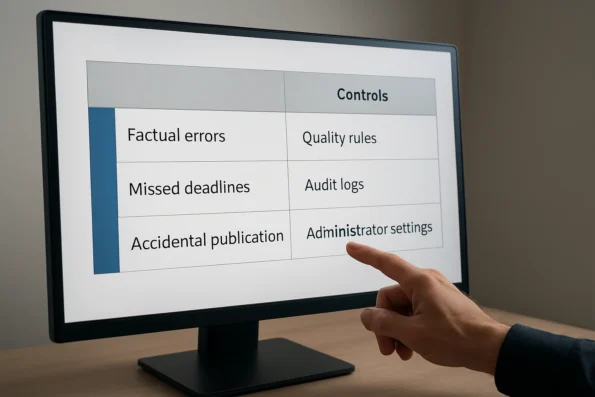
| Risk | Control Mechanisms | Automated/Manual | Evidence Source |
|---|---|---|---|
| Factual errors or duplicate content | Quality rules (customizable thresholds, structural validation), publication blockers to halt non-compliant drafts, and enforced review modes for flagged articles | Automated evaluation and blocking; manual editorial review for resolution | Publisher quality rules, reports and safe publication |
| Accidental or noncompliant publication | Slot eligibility logic that only permits publication of articles meeting all defined quality, content, and compliance criteria; audit logs of all publication events; administrator-only modification of workflow configuration | Automated slot checks and logging; manual configuration by privileged users | Publisher quality rules, reports and safe publication |
| Slot failures or missed publication deadlines | Systematic background job logs for each scheduled slot, real-time status indicators, and a troubleshooting checklist for diagnosing interruptions or queue failures | Automated logging; manual diagnosis and intervention when failures are detected | Publisher troubleshooting master checklist |
| Undetected workflow errors or unintended automation actions | Comprehensive audit trails and content state histories, which track changes and transitions between workflow states; mandatory manual checkpoints before and after automation is rolled out or updated | Automated state tracking; manual verification by editorial leads or administrators | Publisher quality rules, reports and safe publication |
| Inventory overlap and cannibalisation | Automated detection rules to flag overlapping topics or duplicated content inventory, with flagged cases requiring human review and decision on resolution | Detection is automated; conflict resolution is manual | Publisher quality rules, reports and safe publication |
| Inadequate version tracking or rollback capability | Draft status management, publication logs for traceability, and recommended manual backups for critical content; no automated, full version rollback | Automated logging; manual backup management | Publisher quality rules, reports and safe publication |
| Inconsistent application of quality or compliance standards | Centralized configuration of scoring rules, publication blockers, and explicit rule documentation; periodic manual review of rule effectiveness and compliance logs | Automation enforces rules; ongoing manual review required | Publisher quality rules, reports and safe publication |
| Loss of auditability or transparency in automated decisions | Detailed content and workflow logs, including record of slot attempts, review state changes, and all manual overrides; regular manual audits for governance | Automated logging supported by manual audits | Publisher quality rules, reports and safe publication |
This table demonstrates that robust AI editorial workflow automation depends not only on technical safeguards—such as quality scoring, publication blockers, slot eligibility, and audit logs—but also on deliberate, ongoing human involvement. Automated controls can enforce baseline standards, automatically detect compliance or scheduling risks, and provide detailed logs for later review. However, critical exceptions, nuanced editorial judgments, and final approval for publication remain manual responsibilities. For example, when an article fails a quality threshold, the automation system blocks its publication and escalates to manual review, ensuring only approved content reaches publication. Similarly, while slot failures and workflow errors are systematically logged, effective remediation relies on human diagnosis and follow-up. Automated inventory overlap detection helps surface potential cannibalisation, but editorial teams must resolve these conflicts based on broader content strategy considerations. Ultimately, workflow safety and consistency are sustained through a balance of automated enforcement and transparent, accountable editorial oversight, with detailed audit trails and manual checkpoints forming the backbone of governance. The next section will outline diagnostic steps for safely configuring and operationalizing these controls.
FAQ
What tasks can AI editorial workflow automation reliably handle?
AI editorial workflow automation excels at repetitive and structured tasks, such as routing articles for approval, managing draft and publish states, scheduling content based on predefined intervals, enforcing quality gates, and tracking status changes. These automations work best when grounded in explicit rules and clear operational boundaries. The system can also maintain compliance with slot eligibility by checking that content meets predefined requirements before proceeding, but cannot adapt to unstructured editorial nuances without human input.
How do you configure approval and scheduling workflows with NextlerAI Publisher?
Configure approval and scheduling in NextlerAI Publisher by selecting the desired final status (draft, pending review, or publish) for each workflow, defining quality thresholds, enabling or disabling auto-publish, and specifying scheduling intervals. Slot management and review modes ensure only eligible, quality-approved content progresses through each stage. Administrators can also customize review logic to trigger manual intervention if a content blocker or quality warning is detected, ensuring exceptions are routed for human review before publication.
What are common limitations of AI-driven editorial processes?
AI-driven editorial workflows cannot interpret nuanced editorial judgment, verify legal or brand compliance, or resolve content overlap without human input. Version control is limited to draft states and logs, and automation cannot prevent all errors or guarantee content appropriateness in every context. Additionally, AI systems do not autonomously update their rules in response to evolving editorial standards; all changes to workflows or quality checks must be explicitly configured by administrators.
Which diagnostic steps help prevent workflow setup errors?
Critical diagnostic steps include running initial tests with manual approval, verifying each automation rule and quality blocker, auditing slot execution logs, and incrementally enabling features only after each phase performs correctly. Regular review of audit trails and system reports is essential for safe rollout. Diagnostic workflows should also include controlled role assignments and periodic validation of both WordPress cron scheduling and integration status, allowing early detection of configuration drift or plugin conflicts.
How can teams mitigate risks like accidental publication or quality lapses?
Teams should enforce strict quality rules, require human review for flagged drafts, restrict configuration changes to administrators, and maintain comprehensive audit logs. Automated publication blockers and slot eligibility checks act as safeguards, but manual oversight remains an essential layer of protection. Limiting workflow privileges to trusted personnel and setting up notification alerts for publishing anomalies further helps maintain operational safety and content integrity.
What version control options exist for AI-generated editorial content?
Version control in AI editorial systems typically includes draft and publish state tracking, detailed audit logs of workflow actions, and retention of prior versions in the form of WordPress post revisions. For full rollback, external backups and manual content archiving are still required. Audit trails can be queried to reconstruct the sequence of editorial actions, which supports accountability but does not inherently offer one-click restoration of deleted or corrupted content.
Conclusion
AI editorial workflow automation, when grounded in explicit rules and paired with diligent oversight, offers a reliable framework for streamlining multi-author content production. Its true value emerges not from replacing editorial judgment, but from reinforcing process discipline—ensuring each approval, slot, and revision flows through a verifiable, auditable system. By leveraging automated scheduling, approval routing, and consistent application of quality rules, large teams can maintain operational clarity even as content volume scales.
Effective implementation relies on clear separation of automated and manual tasks. Administrators must routinely verify that slot eligibility checks, review blockers, and quality warnings are functioning as designed. This includes monitoring output logs, confirming that approval routing logic matches organizational standards, and validating that version control mechanisms—such as draft states and audit logs—capture every significant change. When new features or integrations are enabled, administrators should conduct incremental tests in a controlled environment to assess system stability and ensure that no unintended automations bypass human oversight. These actions preserve both editorial accountability and compliance with organizational requirements as automation evolves.
For teams managing complex editorial pipelines, the most effective next action is to designate a workflow administrator responsible for regularly auditing automation settings, reviewing quality rule outcomes, and coordinating any required manual interventions. This role anchors accountability, prevents configuration drift, and enables prompt adjustment as needs evolve, safeguarding both compliance and content integrity throughout the automation lifecycle.